


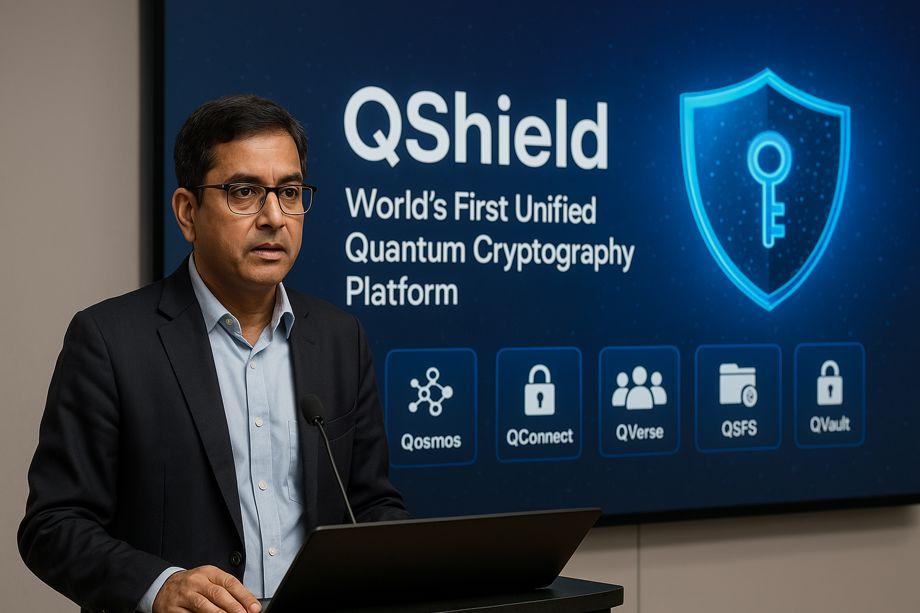
Bengaluru, September 21, 2026: Bengaluru-based quantum cybersecurity company QNu Labs has launched QShield 2.0, a new platform designed to help organisations discover, assess and continuously manage cryptographic risks as quantum computing advances. The platform was unveiled at the company’s 10th-anniversary event in Bengaluru and will power its National Cryptographic Assessment and Assurance Framework (NCAAF).
QShield 2.0 Targets the Quantum Security Challenge
The launch comes as governments and enterprises increasingly examine the long-term security implications of quantum computing. Current encryption systems protect large volumes of financial, government, communications and enterprise data, but sufficiently powerful quantum computers could eventually threaten some widely used public-key cryptographic systems.
QNu Labs says one of the immediate challenges for organisations is simply understanding where cryptography is being used across their technology infrastructure. Encryption algorithms, certificates, keys, libraries and protocols can exist across numerous systems, making it difficult for organisations to establish an accurate picture of their exposure.
QShield 2.0 is designed to address this visibility problem by providing a structured approach to identifying cryptographic assets and evaluating their security posture.
Platform Built Around Discover, Assess and Assure
The company’s NCAAF framework is organised around three continuous processes: Discover, Assess and Assure.
The Discover stage focuses on locating cryptographic assets across an organisation’s systems. Assess evaluates those assets against both classical and quantum-related risks, while Assure is designed to provide continuous validation rather than relying only on periodic security audits.
QNu Labs says QShield 2.0 combines several capabilities within one platform, including Quantum Entropy, Quantum Readiness Risk Assessment, Quantum PKI, Quantum Vault and AI Security. The AI Security component is intended to address cryptographic risks associated with artificial intelligence models and autonomous agents.
The approach is aimed at helping organisations move from simply assuming that their encryption infrastructure is secure to developing greater visibility into its resilience and ability to adapt.
India Pushes Toward Quantum-Ready Infrastructure
The QShield launch comes at a time when India is increasing its focus on quantum technologies and cybersecurity. The Department of Science and Technology is implementing the National Quantum Mission, which has an approved outlay of ₹6,003.5 crore over eight years and focuses on areas including quantum computing, communication, sensing and quantum materials.
A February 2026 task-force report cited by QNu Labs recommended that critical infrastructure sectors begin formal post-quantum cryptography implementation by 2027. This creates an increasing need for organisations to understand their existing cryptographic infrastructure before beginning large-scale migration programmes.
NITI Aayog is also developing a quantum communication risk assessment framework in discussions with regulators including the RBI, SEBI and TRAI. The framework is intended to encourage regulated entities such as banks, stock exchanges and telecom companies to assess whether their systems are prepared for quantum-related security risks.
QNu Labs Expands India’s Quantum Security Ecosystem
QNu Labs was incubated at IIT Madras Research Park and has spent the past decade developing technologies focused on quantum-safe communications and cryptography. The company says its team includes engineers, physicists and mathematicians working across quantum security technologies.
The company has positioned QShield 2.0 as a platform for enterprises and government organisations preparing for the transition toward quantum-resilient security. The launch also included early deployment accounts from banks and security depositories, according to QNu Labs.
With quantum-security requirements increasingly entering national technology discussions, QShield 2.0 places cryptographic visibility, risk assessment and continuous assurance at the centre of India’s emerging quantum-safe cybersecurity ecosystem.


