


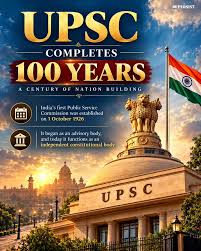
The Union Public Service Commission (UPSC) has completed 100 years, marking a major milestone in India’s institutional history and public-service recruitment system. The centenary celebrations culminated on October 1, 2026, at Bharat Mandapam in New Delhi, where Prime Minister Narendra Modi participated in the programme and addressed officials, public-service stakeholders and civil-services aspirants.
The occasion marked a century since the establishment of the first Public Service Commission in India on October 1, 1926. What began as an advisory institution during the colonial period subsequently evolved into the constitutional body responsible for conducting recruitment examinations for several key services of the Government of India.
From 1926 Institution to Constitutional Body
The first Public Service Commission was established in 1926 following recommendations of the Lee Commission. After Independence, the institution underwent significant changes and ultimately became the Union Public Service Commission under the Constitution of India.
Today, UPSC operates under Article 315 and plays a central role in recruitment to several Union government services. Its responsibilities extend beyond examinations to include advice on appointments, promotions, transfers and disciplinary matters involving public services.
Over the decades, the Commission has become closely associated with examinations such as the Civil Services Examination, which recruits officers for services including the Indian Administrative Service, Indian Police Service and Indian Foreign Service.
Centenary Celebrations at Bharat Mandapam
The two-day centenary programme, titled “Shatabdi Samaroh – Manthan,” began on September 30 at Bharat Mandapam. It brought together senior government officials, members and chairpersons of State Public Service Commissions, academics and other stakeholders to discuss the changing requirements of public administration and recruitment.
On October 1, Prime Minister Modi participated in the main centenary ceremony. The programme included the release of a commemorative postage stamp, a special coin and a book titled “100 Landmark Judgements – Shaping the Policies of UPSC and Public Service Commissions in India.”
The commemorative releases highlighted the institution’s century-long journey and its role in India’s public-service recruitment framework.
Focus Shifts Toward Future-Ready Recruitment
The centenary programme also placed significant emphasis on the future of public-service recruitment. UPSC Chairman Dr. Ajay Kumar outlined three guiding principles for the Commission’s next phase: trust, transparency and technology.
The Commission has discussed reforms aimed at strengthening examination integrity and modernising the candidate experience. These include digital admit cards, facial authentication, expanded examination centres and technology-enabled systems.
According to reporting from the Indian Express, UPSC is also examining ways to assess reasoning, spontaneous thinking and judgement under ambiguity rather than relying primarily on predictable or coached responses.
The discussions reflect a broader challenge facing public institutions: adapting recruitment systems to changing technology and governance requirements while retaining principles of merit, fairness and equal opportunity.
A Century of Public-Service Aspirations
For millions of Indian aspirants, UPSC represents more than an examination authority. Its civil-services examinations have become an important pathway into public administration and have shaped generations of government officials.
The centenary therefore marks both an institutional milestone and a moment to consider how India’s public-service system should evolve over the coming decades.
As UPSC enters its second century, its stated focus on technology, transparency and institutional trust signals an effort to modernise recruitment while preserving the constitutional principles at the core of its role.


