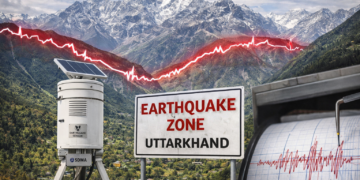


The government of Uttarakhand is planning to add sensors to its earthquake early warning system. They want to have 500 sensors over the state. This will help them to prepare better for disasters in the region. The officials say that this will make a difference in detecting seismic activity and sending alerts to people who live in areas that are prone to earthquakes.
Uttarakhand is located in a seismic area, which means it is very likely to have earthquakes. This is because the Indian and Eurasian tectonic plates are colliding. Many towns and cities in Uttarakhand are in Seismic Zone IV and Zone V which’re the most earthquake-sensitive areas in India. Because of this the authorities are trying to improve their monitoring systems and early warning technology.
Now the state has a network of earthquake sensors that are managed by the Uttarakhand State Disaster Management Authority. These sensors can detect the seismic waves that are produced during an earthquake and send the data to the monitoring centers. The system can send alerts within seconds, which gives people some time to take action to protect themselves.
The new plan is to add sensors so there will be around 500 of them. This will create a network of sensors all over the state including in the mountains and cities. The officials say that this will make the earthquake detection more accurate and will allow warnings to reach areas quickly.
The early warning system works by detecting the waves, which are the fastest but cause the least damage. When these waves are detected the system sends alerts before the destructive secondary waves arrive. Even though the warning time is a few seconds to half a minute it can be enough time to stop trains shut down factories turn off gas lines and allow people to move to safer areas.
The authorities believe that the expansion of the sensor network will help to protect the cities like Dehradun, Haridwar, Nainital and Rudraprayag as well as the remote hill districts where it is hard to respond to earthquakes because of the difficult terrain.
The officials also plan to connect the sensor network to alerts, siren systems and emergency communication networks so that warnings can be sent to people instantly. They also want to connect schools, hospitals and government buildings to the system so that people can be evacuated or take safety measures quickly.
Experts say that earthquake warning systems cannot stop earthquakes from happening but they can reduce the number of casualties and damage by giving people a few critical seconds to respond. Countries like Japan and Mexico already have systems that have been proven to be effective in minimizing the impact of disasters.
The government of Uttarakhand says that the expansion of the sensor network is part of a plan to improve disaster resilience in the state. They are also working on public awareness campaigns building earthquake- infrastructure and improving emergency response mechanisms.
As the seismic risks continue to threaten the regions strengthening the monitoring systems is seen as a crucial step to protect lives and infrastructure in Uttarakhand. The Uttarakhand government is taking steps to make sure that the state is better prepared for earthquakes and other disasters. The earthquake early warning system is a part of this effort and the expansion of the sensor network is an important step forward. The Uttarakhand government is committed to making the state safer and more resilient, to disasters.


