


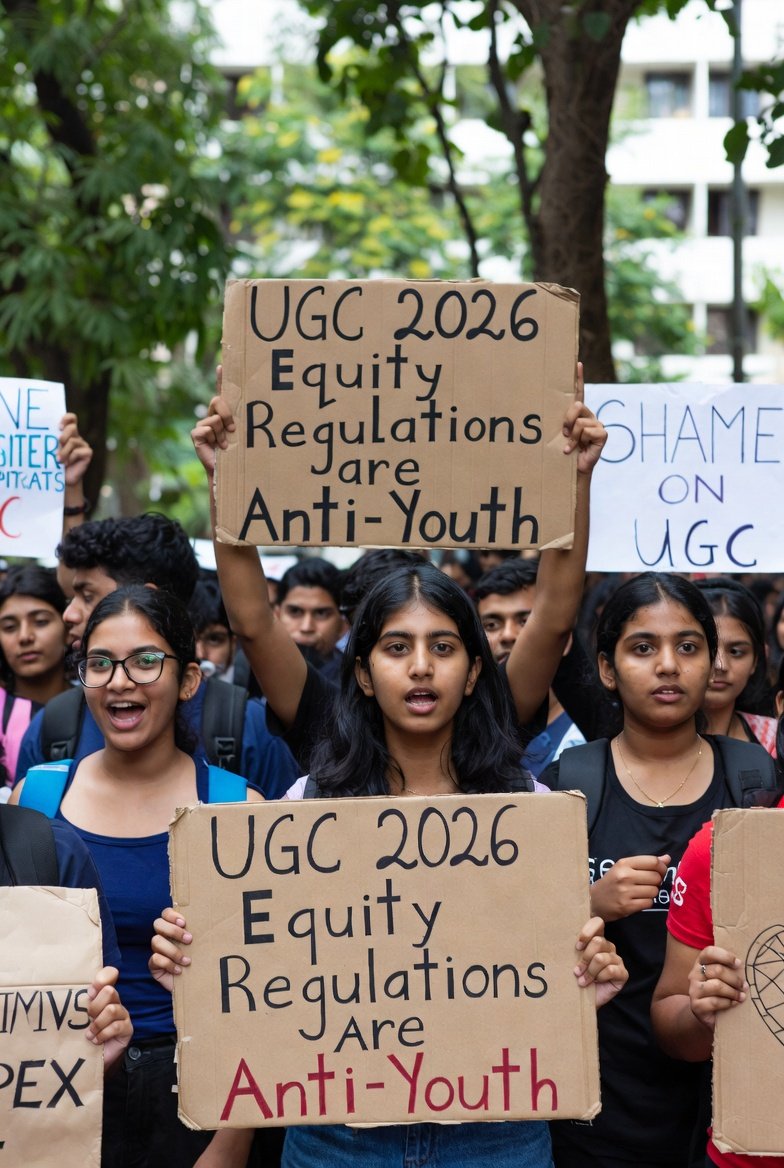
The Supreme Court of India is really worried about the UGC Equity Regulations 2026. They think these rules can cause problems if they are put into action without being looked at more carefully. A group of judges led by Justice Surya Kant and Justice Joymalya Bagchi said that the UGC Equity Regulations 2026 could split society or be used in the way. So the court has decided to stop the UGC Equity Regulations 2026 from being enforced for now. The Supreme Court of India wants to take a look, at the UGC Equity Regulations 2026 before they are put into action.
The judges sat down to talk about the rules during the hearing. They said these rules bring up some questions about what is fair and what the law says. The main issue is how these rules define and deal with discrimination at colleges and universities. The judges were worried that if the rules are too broad or not clear people might interpret them in ways, which could cause problems on campus instead of making things more equal. The court said that any rule that tries to make things fair for everyone must be written clearly and apply to everyone in the same way so that all people are treated fairly. The court wants to make sure that the rules are fair for all sections of society and that everyone gets the treatment that is what the rules for social justice need to be like the rules, for social justice need to be fair.
The Supreme Court sent a notice to the Union Government and the University Grants Commission as part of its interim order. They want the Union Government and the University Grants Commission to respond to the petitions that say the 2026 regulations are not valid.
The Supreme Court will look at this matter again on 19 March 2026. On that day the court will decide if the 2026 regulations need to be changed if they need to be made safer or if they need to be rewritten. The court will examine the 2026 regulations to see what needs to be done.
The UGC Equity Regulations 2026 were brought in to make universities and colleges better places for everyone. They wanted to set up Equal Opportunity Centres and equity committees to help with this. They also wanted to make it easier for people to complain if they were not treated fairly.. Some people did not agree with these rules. They thought that some parts of the UGC Equity Regulations 2026 were unfair and might be used in the way. They were worried that the UGC Equity Regulations 2026 could be used to help some people but not others and that this could cause problems. The UGC Equity Regulations 2026 were supposed to help with discrimination, in universities and colleges. These people thought that they might not work as planned.
The court also said that the 2012 UGC anti-discrimination regulations will still be used until a final decision is made. This means that schools and colleges will have rules to follow while the court figures out if the new rules are fair or not. The 2012 UGC anti-discrimination regulations will keep being used for now.
The Supreme Court is getting involved at a time when students over the country are protesting and people are talking about it a lot. People have opinions about this at schools and in politics. Some people think that the courts decision to wait is slowing down changes that will help students who are not treated fairly. The Supreme Court is getting involved in this issue. Other people are happy that the court is being careful. They say that big decisions that affect society for a time need to be looked at very closely by the court. The Supreme Courts decision is important for students and, for the country.
Legal experts think this case is very important because it will show how education rules can be fair for everyone. The education policy has to balance being fair, to all people and also being equal. The result of the March hearing will be big because it will decide what happens to the rules that watch over education. It will decide if the 2026 regulations are kept, changed or stopped for good. The future of education and the education policy will be affected by what happens in this case.
For now, the apex court has made its position clear: reforms aimed at equity must be clear, inclusive, and legally sound, ensuring they unite rather than divide academic communities.


