

Love Should Not Turn Toxic, Says Kamal Haasan on Language Debate
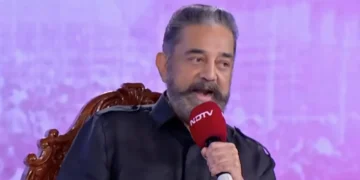
Actor and politician Kamal Haasan has once again stepped into the national language debate, delivering a strong and thoughtful message at NDTV’s Tamil Nadu Summit. Addressing questions around Hindi, Tamil identity, and political narratives, Haasan said that love for a language should never turn into hatred for another and must never be forced on people.
His remarks come at a time when the discussion around alleged Hindi imposition has intensified, especially in Tamil Nadu, where language has long been tied to cultural identity and political movements.
Language Is Pride, Not a Weapon
Love Does Not Need Hate to Survive
Kamal Haasan compared love for language to personal relationships, saying it must always be mutual and voluntary. According to him, loving one’s mother tongue does not require rejecting or opposing another language.
He explained that language is a form of cultural pride, something deeply personal, but it should stop there. Turning that pride into hostility, he said, defeats the very purpose of communication.
Haasan stressed that respect works both ways. If one wants others to appreciate their language, the first step is to show equal respect for theirs.
“Do Not Impose, Leave the Choice to the People”
Clear Stand Against Forced Language Learning
When asked whether language pride is increasingly being turned into political ideology, Haasan made his position clear. He said languages should never be imposed, regardless of intent.
He argued that language learning works best when it comes from curiosity and affection, not pressure. According to him, people naturally learn new languages when they feel welcomed, not when they feel threatened.
He described language as a tool for communication, but also as an extension of personal emotion and identity. For him, language is expression, feeling, and individuality combined.
Is Language Being Used for Political Narratives?
“Love Should Never Become Toxic”
Pressed further on whether language debates are being used to create political divisions, Haasan responded with a striking line. He said love should never become toxic, whether it is love for a person, an idea, or a language.
He compared linguistic harmony to a marriage, saying even a marriage of languages cannot survive if it is forced. Mutual respect, he said, is the only foundation that works.
Once again, he returned to the idea of choice, saying people must be free to decide what languages they learn and use.
The Larger Context: Tamil Nadu vs Centre on Hindi
Ongoing Political Tussle
Haasan’s remarks come amid an ongoing disagreement between the Tamil Nadu government and the central government. The ruling DMK has repeatedly accused the Centre of pushing Hindi at the cost of regional languages.
Tamil Nadu recently introduced its own State Education Policy, continuing with a two-language formula instead of the three-language formula promoted at the national level.
Udhayanidhi Stalin Reiterates Opposition to Hindi Imposition
Remembering the Language Agitations
Adding to the debate, Tamil Nadu Deputy Chief Minister Udhayanidhi Stalin recently reaffirmed the state’s strong opposition to Hindi imposition during a public event in Chennai.
Speaking on Veera Vanakkam Day, observed in memory of those who died during the language agitation of the late 1930s, he said Tamil Nadu would never accept forced Hindi learning.
He reminded the audience that people in the state had sacrificed their lives to protect their mother tongue, making Tamil Nadu’s resistance historically unique.
Fear of Losing Mother Tongues
“Hindi Swallows Other Languages,” Says Stalin
Udhayanidhi Stalin pointed out that several mother tongues in northern India gradually declined after Hindi became dominant. He argued that languages once spoken widely in states like Bihar, Haryana, and Uttar Pradesh lost ground over time.
According to him, this fear of cultural erosion is why Tamil Nadu has consistently opposed any form of Hindi imposition.
Kamal Haasan’s Personal Language Journey
Learning Hindi by Choice, Not Force
Sharing a personal anecdote, Kamal Haasan revealed that he learnt Hindi only at the age of 27. He made it clear that no one forced him to learn the language.
He said he left the choice to himself and learnt Hindi out of interest and interaction, not obligation. His first exposure to Hindi, he recalled humorously, came from friends teasing him with words he did not understand.
Instead of reacting negatively, he asked them to explain the meaning. That curiosity, he said, became the foundation of his learning journey.
From Curiosity to Comfort
How Love for Language Grows
Haasan explained that when learning begins without pressure, curiosity slowly turns into affection. Over time, that affection deepens into genuine understanding.
He said this process applies equally to anyone learning Tamil, Hindi, or any other language. Hatred, he warned, blocks learning, while openness invites it.
He added that while he can speak Hindi and understands its dialects, he still cannot write the language fluently.
A Light Moment: Scholar of Cinema
Applause-Filled Response at the Summit
In a lighter moment during the summit, Haasan joked about his own literacy. He said he has a strange distinction of being not very literate in six languages, while claiming some level of expertise in only three.
When asked which three, he replied with confidence: Tamil, English, and cinema.
The audience responded with loud applause when he described cinema as a language of its own. He explained that cinema can communicate across cultures and languages, especially with the help of subtitles.
Past Language Controversy Revisited
Clarifying His Kannada-Tamil Remark
Haasan also addressed a controversy from last year when his comment suggesting Kannada was born out of Tamil sparked backlash.
He clarified that his statement was made out of love and was based on what historians had taught him. He said he never intended to insult or diminish any language.
To underline Tamil Nadu’s inclusive history, he pointed out that the state has had chief ministers from diverse linguistic and cultural backgrounds, including Malayali, Telugu, Tamil, and Kannada-speaking communities.
“Politicians Are Not Language Experts”
A Rare Admission
In a moment of self-reflection, Haasan admitted that politicians, including himself, are not always qualified to speak authoritatively on language history.
This candid remark drew appreciation, as he emphasized the need for humility and learning when discussing sensitive cultural topics.
Why Kamal Haasan’s Words Matter
A Voice of Balance in a Polarised Debate
At a time when language debates often turn emotional and divisive, Haasan’s comments struck a different tone. He did not dismiss pride in Tamil, nor did he endorse hostility toward Hindi.
Instead, he positioned choice, respect, and mutual understanding as the only sustainable path forward.
His message resonated with many because it addressed both identity and coexistence without framing language as a battlefield.
Final Thoughts
Kamal Haasan’s remarks at the Tamil Nadu Summit offer a reminder that language, at its core, exists to connect people, not divide them. His insistence on choice over compulsion and love over hate adds a human dimension to an otherwise political debate.
As discussions around language policy continue, voices like his highlight the importance of empathy, cultural respect, and personal freedom in shaping a multilingual nation.


