


Why India Has Not Joined Trump’s Board of Peace Yet
India has chosen to stay on the sidelines, at least for now, after receiving an invitation to join US President Donald Trump’s newly announced Board of Peace. While several countries have already signed up, India is taking a wait-and-watch approach, closely observing how the initiative develops and what it could mean for global diplomacy.
The Board of Peace was unveiled by Trump during the World Economic Forum in Davos, Switzerland, and was initially projected as a body to oversee the Gaza ceasefire and post-war reconstruction. However, its mandate has since expanded dramatically, raising questions and concerns among several countries, including India.
What Is Trump’s Board of Peace?
From Gaza to Global Conflicts
The Board of Peace was originally conceived as a mechanism to monitor the Gaza ceasefire and guide reconstruction efforts after the war between Hamas and Israel. But the official charter of the board reveals a much broader ambition.
The body now aims to promote stability and ensure lasting peace in conflict-hit regions worldwide. Trump himself has suggested that once the board is fully formed, it could intervene in multiple global conflicts, going well beyond Gaza.
A Body With Sweeping Powers
According to the charter, the Board of Peace will work on conflict resolution, stability, and peacebuilding across regions. Trump has openly stated that the board could take on “numerous other things” beyond its initial scope, once operational.
This wide-ranging authority has led to concerns that the board could overlap with or even undermine existing international institutions, particularly the United Nations.
Who Has Joined the Board So Far
Countries That Have Signed On
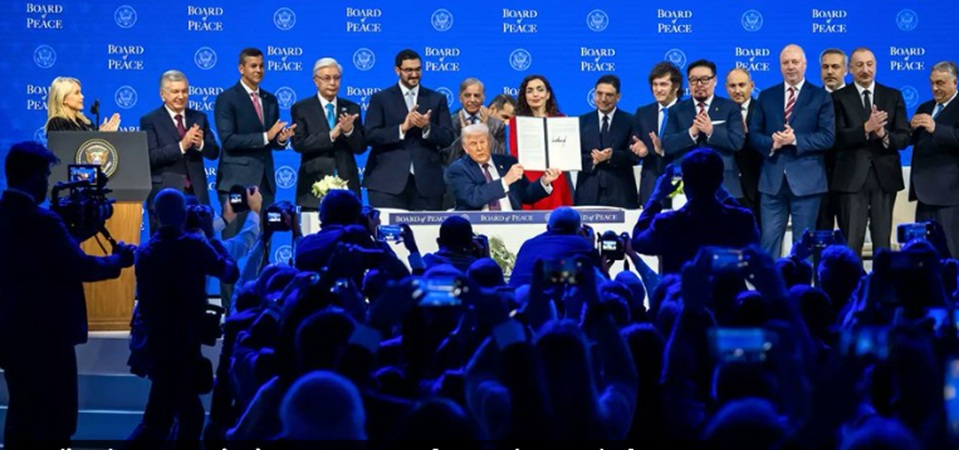
So far, 11 countries have formally joined the Board of Peace by signing its charter. These include Argentina, Armenia, Azerbaijan, Bulgaria, Hungary, Indonesia, Kazakhstan, Kosovo, Pakistan, Paraguay, and Uzbekistan.
In addition, senior officials from eight other countries, including Bahrain, Jordan, Morocco, Qatar, Saudi Arabia, Turkey, the UAE, and Mongolia, attended the signing ceremony.
Absence of Major Global Powers
Notably, no permanent member of the UN Security Council, apart from the United States itself, has joined the board. None of the G7 nations have signed up either.
This absence has raised questions about the board’s global legitimacy and whether it can function effectively without the backing of major powers.
India’s Position: Invite Accepted, Decision Pending
India Was Invited but Did Not Attend
India was among nearly 60 countries that received invitations to join the Board of Peace. However, no Indian officials were present at the launch ceremony in Davos.
Officials familiar with the matter said India has not yet made a final decision on whether to join and is carefully evaluating the implications of becoming part of the initiative.
Watching Key Partners Closely
India is reportedly monitoring the positions taken by its key international partners, including France and Russia. Their decisions could influence New Delhi’s final stance.
At the same time, there are concerns within the Indian establishment about the long-term impact of the board on existing global institutions.
Concerns About Undermining the United Nations
A Parallel Power Structure?
One of India’s main concerns is that Trump’s Board of Peace could weaken or sideline the United Nations, which remains the primary global body for conflict resolution and peacekeeping.
The board’s charter does not clearly define how it will coordinate with the UN, and Trump’s statements have added to the uncertainty.
Trump’s Permanent Role Raises Questions
Another point of concern is Trump’s position as the board’s chairman. Reports suggest that Trump could remain chairman indefinitely, giving him long-term control over the body’s agenda and actions.
For countries like India, which strongly support multilateralism and institutional balance, this raises red flags.
Trump’s Claims and India’s Disagreement
Claims of Ending Eight Wars
During the Davos ceremony, Trump claimed credit for ending eight wars in nine months. Among these, he included the military standoff between India and Pakistan last May.
Trump said Pakistan’s Prime Minister Shehbaz Sharif had praised him for preventing a major escalation and saving millions of lives.
India Rejects These Claims
India has firmly rejected Trump’s assertion that he played a role in ending the conflict with Pakistan. According to New Delhi, the situation de-escalated after four days through direct communication between Indian and Pakistani military officials.
India has consistently maintained that there was no third-party mediation in the matter.
Pakistan’s Participation Adds to Sensitivities
Pakistan Joins the Board
Pakistan is among the countries that have joined the Board of Peace, which has added another layer of complexity to India’s decision-making.
Trump publicly highlighted Pakistan’s participation and repeated claims that he helped avert a major conflict between the two nuclear-armed neighbours.
Strategic Calculations for India
Given India’s longstanding position against external mediation in bilateral issues, especially with Pakistan, joining a body that includes Pakistan and promotes intervention in conflicts raises strategic concerns.
No Mention of Gaza in the Charter
A Surprising Omission
Despite being the original reason for the board’s creation, Gaza does not feature prominently in the official charter of the Board of Peace.
Instead, the document focuses on broad goals such as stability, peace, and conflict resolution across regions.
Expanding Ambitions
Trump has openly stated that once the board completes its work in Gaza, it could take on other global crises. This open-ended mandate has made several countries cautious.
How the Board Views the UN
Cooperation or Competition?
Trump has said the Board of Peace could work alongside the United Nations. However, he has also claimed that the UN had no role in the conflicts he says he helped resolve.
By asserting that the UN did not contribute to ending the conflicts he listed, Trump has fuelled concerns that the board may seek to position itself as a rival rather than a partner.
Why India Is Taking a Cautious Approach
Commitment to Multilateralism
India has long supported a rules-based international order and multilateral institutions like the UN. Any initiative perceived as weakening these structures is likely to face scrutiny in New Delhi.
Strategic Autonomy
India’s foreign policy emphasises strategic autonomy and careful balancing between global powers. Joining a US-led body with unclear authority and long-term implications does not align easily with this approach.
What Happens Next
Decision Still Open
Indian officials have indicated that no final decision has been taken yet. The situation remains under review, and India will continue to assess how the Board of Peace evolves.
Much Depends on Global Response
The future credibility and influence of the Board of Peace will depend on whether more major countries choose to join and how it positions itself alongside existing institutions.
For now, India appears content to observe from the sidelines, weighing the risks and benefits before making any move.
The Bigger Picture
Trump’s Board of Peace represents an ambitious attempt to reshape global conflict resolution. Whether it becomes a meaningful platform or remains a controversial initiative remains to be seen.
India’s cautious stance reflects broader global uncertainty about the board’s role, intentions, and long-term impact on the international system.


