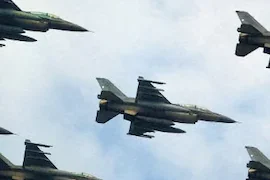


The recent United States government approval for a large upgrade package for Pakistan’s F-16 fighter jets has triggered considerable debate and discussion in South Asia, with particular focus on India, which closely monitors this issue to better understand its implications. The upgrade package, which costs several hundred million dollars, encompasses state-of-the art avionics, radar, and weapons capabilities. To Islamabad, these upgrades are highly imperative for ensuring air force readiness. Conversely, India remains acutely familiar with these developments relating to an imbalance of military power and geostrategic signals from Washington.
B. The Indian perspective on US military aid to Pakistan, particularly involving weapons systems such as F-16s, which have played a pivotal role in the air warfare plans of Pakistan, has been one of concern. While it has been made amply clear that these deliveries are intended to fortify Pakistani capabilities against terrorism, it is widely argued within Indian strategic circles that instead, these capabilities will be geared towards greatly expanded uses. There would be an impact on air warfare in South Asia itself.
According to strategic observers, timing plays an imperative role. The relationship between India and the United States has been very cordial in recent times. It began with defense and technology collaborations and mutual apprehensions about China’s rising assertiveness. In light of the developments, recent US moves on Pakistan’s air force have somewhat stunned Indian policymakers. Although there are no hints at it being a setback, it is also understood that it needs to be understood within larger parameters.
As regards Pakistan, it has welcomed the news about modernizing these aircraft as it represents a diplomatic victory for it and constitutes an endorsement of its traditional security tie with Washington. Its air force has relied on its F-16 jets for several decades. Nevertheless, with these upgrades, it would be assured that it would have competitive aircraft for several years to come. Pakistani strategists believe that these modernizations allow it to maintain deterrence within the region due to varying military developments, such as developments within India with regard to its purchases of modern aircraft, including its Tejas planes.
Reactions in India vary from cautious government pronouncements to more nuanced analyses offered by ex-militaryıs. Former air force commanders point out that, while these modernizations allow for additional Pakistani capabilities, India retains qualitative and quantitative superiority. But they stress that Indiaıs latest generation of fighters, advances in surveillance capabilities, and overall air defense systems offer ample deterrence against emerging threats. Nonetheless, they believe it necessary to remain modern and alert as regional security challenges shift.
The issue also sparks debate regarding US diplomatic signals. Certain Indian analysts have seen this upgrade package as a strategy adopted by the US to have some sort of hold on Pakistan, given regional stability and geopolitical rivalry between China and the US. It should be noted that Pakistan’s relationship with China on economic and military fronts has caused uncertainties for the US, and as a result, there might be a strategy on behalf of the US regarding F-16 support.
Despite these reservations, it appears that the Indian government has shown restraint. Their reaction came through diplomatic efforts. According to observers, India’s confidence can be attributed, at least in part, to its developing relationship with the United States. India and the United States have a number of agreements that include joint military exercises, selling sophisticated weapons, and intelligence-sharing collaboration on Indo-Pacific policy. It will be highly unlikely that the F-16 deal will affect India-US relations. Despite this, the fact remains that South Asia’s security dynamics continue to be nuanced. A change in security capabilities, no matter how legitimate from a counter-terrorism perspective, affects regional perceptions and deterrence. The implications here are several. On India’s side, it emphasizes the importance of developing its defense modernization and local production capabilities and working on regional interoperability with trusted partners. On the Pakistani side, it carries some value as a ‘mood-booster’ and operational advantage, but not significantly so. As nations within the region look ahead to what an upgrade will look like for Pakistan’s F-16s, geopolitical strategists within South Asia continue to watch these developments. It once again underscores a level of global politics and geopolitics that reminds nations within South Asia that even an upgrade will have significant geopolitical implications.


