

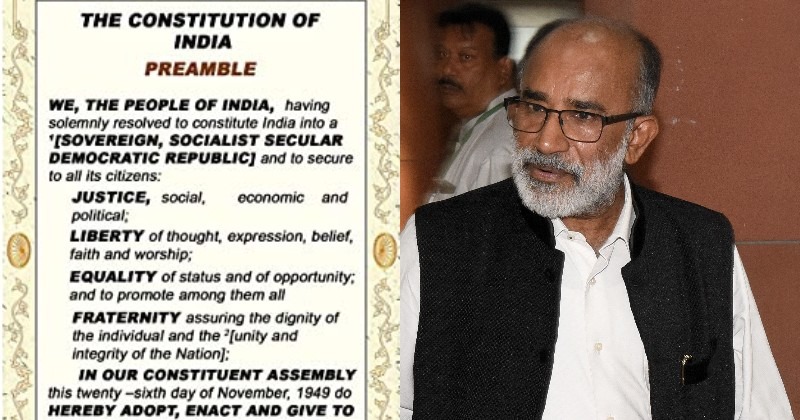
A BJP Member of Parliament has moved a controversial private member’s bill aiming to amend the Preamble of the Indian Constitution by deleting the words “secular” and “socialist.” The move has sparked a loud political and constitutional debate in the country, with opposition parties describing it as an “attack on the foundational character” of India, even as the ruling party contends that the proposal reflects long-standing concerns about interpretations of these terms.
The bill, moved to the Lok Sabha on Friday, contends that the words “socialist” and “secular,” inserted through the 42nd Constitutional Amendment in 1976, were not part of the original constitution-making intent. The MP argued that since these words had been inserted during the Emergency without national consensus, they deserve to be revisited. The preamble, according to the motion, should state the “true and eternal spirit” of the Constitution, as it was originally enacted on 26 November 1949.
The MP further claimed that the word “socialist” creates unnecessary constraints on India’s economic direction, especially at a time when the nation has embraced liberalization, private enterprise, and a globally competitive market system. “The Constitution should reflect economic freedom, choice, and innovation,” the MP said, adding that the word “socialist” may send mixed signals about India’s economic philosophy in the modern global context.
Critics find this cry for scrubbing “secular” from the Preamble particularly provocative. India was intrinsically pluralistic and culturally inclusive, argued the MP, and it does not need to have the word “secular” defined by the state. The “spirit of secularism” is embedded in the Constitution’s Articles and the judicial pronouncements, making the wording of the Preamble redundant, according to him. However, opposition leaders across the political spectrum have strongly rejected this reasoning and accused the BJP of attempting to dilute the secular fabric of the nation.
The proposal immediately sparked an uproar in Parliament, with MPs from Congress, the Trinamool Congress, DMK, Left parties, and others vociferously protesting the move. Many leaders argued that the Preamble is not just a symbolic introduction but a guiding philosophy reflecting commitment to equality, liberty, justice, and fraternity in India. Doing away with “secular” and “socialist”, they say would blur the essential character of the Republic.
Legal scholars differ in opinion, too. Some constitutional experts argue that the Preamble is part of the Constitution’s basic structure, as laid down by the Supreme Court in several landmark judgments. Since the basic structure doctrine bars Parliament from changing the Constitution’s fundamental character, removing these words would be subjected to much judicial examination. Others hold that as long as such words were inserted by an amendment, another amendment can, theoretically, delete or change the wording – provided such a constitutional amendment does not infringe upon the basic structure.
The government has, however, sought to distance itself from the bill, categorically stating that it was a private member’s bill, which has conventionally had very poor chances of passage. In India, private members’ bills seldom get enacted into laws as these require full parliamentary approval and backing by the government. Senior BJP leaders have maintained that this proposal represents the MP’s personal view and does not necessarily reflect the party’s official position.
The bill, in spite of such an assertion, propelled a widespread debate on social media and among intellectual circles. While supporters say that the Constitution should keep up with the times and that revisiting some terms would clarify the national direction of India, critics argue that it is part of a broader ideological effort to reshape the nation’s constitutional values. Political analysts interpreted this as a bill introduced not for immediate action, but rather for the sake of discussion. They say such bills help raise ideological questions before the public, especially when serious political events or elections are imminent. For now, the bill will be debated in the coming sessions of parliament, though its chances are slim. What is certain, however, is that the proposal has revived long-standing debates about India’s constitutional identity, the meaning of secularism, and the balance between tradition and modernity.


