


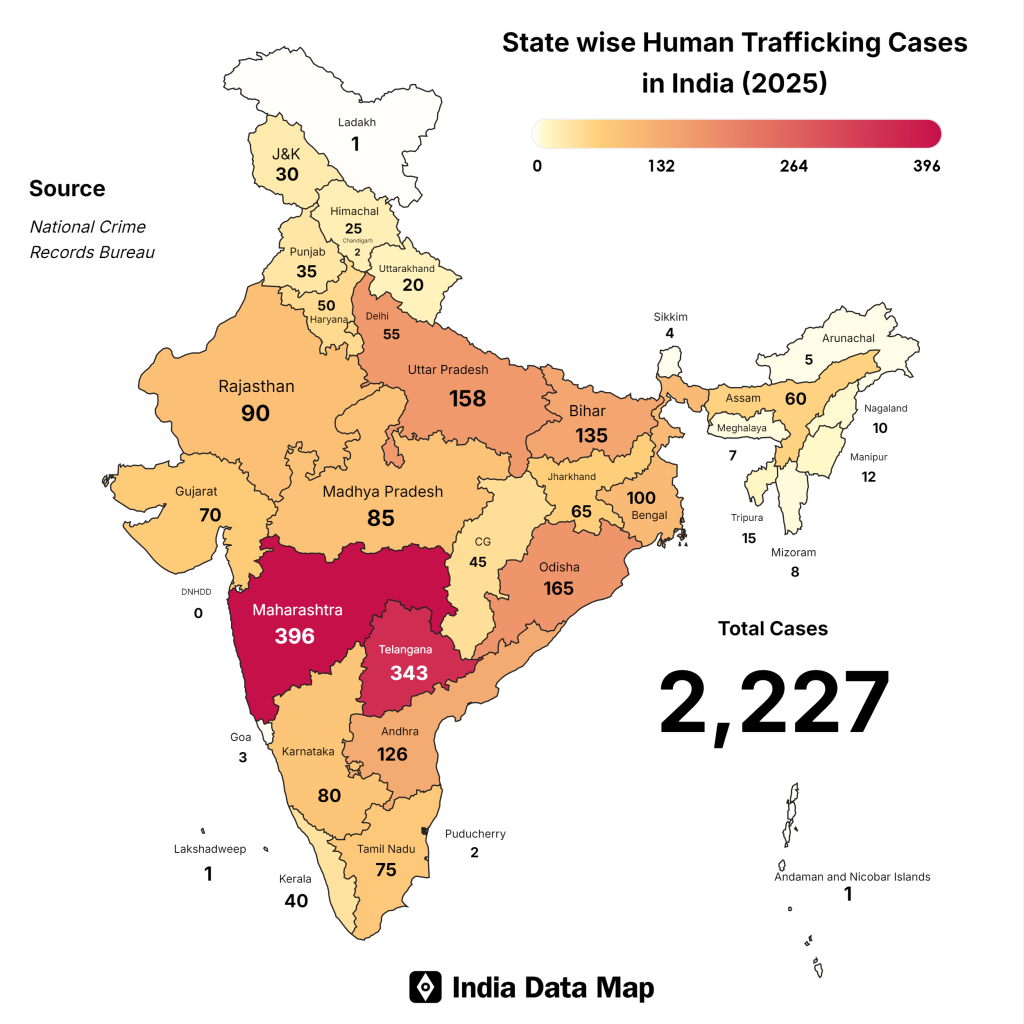
A recent government assessment has revealed a disturbing rise in cases of human-trafficking across India, with Punjab emerging as the state reporting the maximum number of incidents in the latest available data. The revelation has raised serious concerns among policymakers, rights groups, and law-enforcement agencies, calling for stronger surveillance, improved rehabilitation systems, and better coordination across borders.
Officials attribute the sharp rise in cases to be due to a combination of economic vulnerabilities, migration patterns, organised trafficking networks, and the location of the state as a key transit point for both domestic and international routes. According to this report, many victims are lured with false promises of jobs, education, or overseas opportunities, especially women, children, and migrant labourers.
Why Punjab Tops the List
Experts attribute this to a number of socio-economic realities that place Punjab at the top. Over the years, the state has seen a high aspiration for foreign migration, thereby making its residents particularly vulnerable to fraudulent agents and illegal immigration networks. Most of these networks thrive on economic distress and promise lucrative opportunities abroad in return for hefty payments. When families fail to verify the authenticity of agents, victims fall prey to labour trafficking, forced domestic work, and even sexual exploitation.
Besides this, internal trafficking has increased in Punjab, particularly from the poorer districts where scarcity of jobs pushes people into more risky situations. Activists say insufficient enforcement and gaps in coordination among districts have allowed trafficking networks to flourish.
Children Among the Worst Hit
Perhaps most disturbingly, the report highlights a trend: a significant percentage of trafficking victims are minors. Children are trafficked for forced labour, begging rackets, domestic servitude, and sometimes exploitation in illegal activities. In certain cases, traffickers target children from vulnerable families by offering education or training opportunities, only to trap them in exploitative environments.
Child rights organisations have warned that the rates of school dropouts, along with migration-related pressure, raise the vulnerability of minors manyfold. Many children are transported across state borders, making rescue operations and legal proceedings more complicated.
Government’s Response and Policy Measures
Exhortations have been sent by the Centre in view of the alarming findings to state administrations, especially Punjab, to strengthen the anti-trafficking mechanisms by increasing the number of Anti-Human Trafficking Units, improving coordination between police and border agencies, and deploying specialized teams for surveillance as well as rescue missions.
Punjab officials say the government is increasing its crackdown on illegal immigration agents and trafficking syndicates. Several new awareness campaigns have also been launched across rural districts, informing residents of the dangers posed by unverified travel agents and the legal consequences associated with trafficking-related crimes.
The Home Ministry has also stressed the need for updating and streamlining the national anti-trafficking database to ensure that cases are documented accurately and that intelligence is shared in real time across state lines.
Challenges in Enforcement
Despite policy moves, trafficking remains complicated to address. Enforcement agencies face a number of challenges:
Deeply entrenched trafficking networks operating across states.
Underreporting because of stigma, fear, or lack of awareness
Slow rehabilitation processes that leave many survivors without support.
Cross-border control limitations, particularly in border areas close to international boundaries
According to the officials, dismantling trafficking networks takes long-term efforts: financial tracking, digital surveillance, and collaboration with international partners.
Call for Stronger Victim Support
Human-rights activists insist that equal importance be given to victim rehabilitation alongside enforcement. Many survivors suffer trauma, loss of livelihood, and social stigma. Experts emphasize the need for shelters, psychological counseling, and livelihood training to help them reintegrate into society.
Many NGOs working in Punjab have asked the state to establish fast-track courts for trafficking cases, highlighting that slow judicial processes discourage the victims from seeking justice.
The Road Ahead This was a grim reminder that the cases of human trafficking place Punjab at the top, and that the battle against exploitation in India is far from over. Though the government measures indicate improvement, to achieve long-lasting solutions, it is poverty, unemployment, migration pressure, and lack of awareness that have to be addressed. According to various advocacy groups, human trafficking is not a law-and-order issue but a humanitarian crisis. The attention on Punjab could force stronger countrywide reforms, yet keeping these at the grassroots level will call for sustained efforts in community participation and robust policing to protect vulnerable populations across India.


