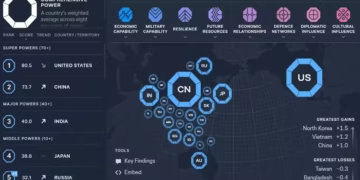


India has reached a milestone in its geopolitical journey, emerging as one of Asia’s leading powers in the 2025 Asia Power Index, published by the Lowy Institute. The latest edition cements India in the category of a “major power,” reflecting its rising economic strength, military capabilities, and future potential-even as the report underlines key areas in which India needs to get better if it is fully to realize its influence in the region.
Top Position Secured by India
The Asia Power Index assesses 27 countries and territories across eight major indicators, such as economic capability, military strength, diplomatic influence, cultural impact, and future resources. In the 2025 ranking, India has secured 40.0 out of 100 points, placing it in the top three, behind only China and the United States, which is included due to its extensive Asian outreach.
Crossing the 40-point mark is a symbolic threshold, placing India formally in the “major power” category. This is significantly better than a few years ago, when India’s scores had hovered in the mid-30s. The rise is underpinned by resilience in economic performance, increased military preparedness, and a clearer diplomatic footprint across the Indo-Pacific.
Key Gains: Where India Excelled
One of the most striking upgrades for India shows up under the economic capability metric, where it ranked third. Strong GDP growth, expanding manufacturing capacity, and consistent foreign investment flows have elevated India’s economic fundamentals. At a time when global supply chains are shifting, India’s potential as an alternative production hub has boosted its regional economic standing.
The future resources indicator, considered one of the most predictive metrics, also gave India a significant push. Being among the youngest nations in Asia, India is well-positioned owing to a demographic dividend, fast-digitizing economy, and an expansion in urbanization. All these factors put together enhanced India’s long-term potential score.
Another area in which noticeable improvement is identified is military capability. India’s increased spending on defense modernization, indigenous weapons systems, and strategic programs such as deep-sea surveillance and aerospace capability contributed to a higher military power score. Recent military operations and modernization of naval assets, along with strategic partnerships, have reinforced India’s preparedness and role in regional security.
The Persistent Weak Spots
These achievements notwithstanding, the Asia Power Index underlines a set of weaknesses that prevent India from realizing its full potential.
This gap is most striking in defence networks, where India ranks outside the top 10. While India does have strong bilateral relations, it does not have the dense security alliances that a country like Japan or Australia does. Its cautious approach to formal defense pacts limits its influence despite its capabilities.
Another challenge is the “power gap”: the difference between the resources that India possesses and its actual conversion of those into regional influence. While it scores high on capability-related areas, there is a lag in diplomatic influence and cultural reach, which indicates underutilization of potential.
The Index also mentions India’s limited influence across Southeast Asia and East Asia, where China, Japan, and South Korea hold stronger economic and diplomatic clout.
Asia’s Geopolitical Landscape is Shifting
India’s rise up the Asia Power Index reflects broader regional shifts. Asia is becoming increasingly multipolar, with more players gaining economic and military heft. Traditional power hierarchies are being rebalanced as trade reforms, strategic competition, and technological advancement continue apace.
In this setting, India’s growing influence carries strategic significance. It positions the country as a counterweight to China in the Indo-Pacific and as one of the few nations able to engage flexibly with West, East, and Southeast Asian blocs. The position of strategic autonomy that India has assumed—neither fully aligned with Western alliances nor dependent on traditional partnerships—has amplified its diplomatic importance.
Challenges Ahead
Despite this positive trend, India’s task is to overcome a set of challenges to sustain and further advance its position. It needs, inter alia, to strengthen its regional alliances, improve diplomatic connectivity, invest in soft-power initiatives, and enhance economic competitiveness. Infrastructure gaps, regulatory issues, and the need for deeper capital markets also require attention.
More importantly, India will have to engage proactively in regional institutions and multilateral platforms to expand its influence.
Conclusion The Asia Power Index 2025 portrays a balanced but optimistic picture of India’s regional standing. With a top-three ranking and recognition as a major Asian power, India’s strategic rise is unmistakable. Its expanding economy, improving military capabilities, and demographic advantages position it as a long-term global player. But to convert that potential into influence, India needs to strengthen networks, deepen regional partnerships, and tap its cultural and diplomatic strengths. As Asia continues to undergo a fundamental transformation, India will be at the forefront of shaping the region’s political and economic architecture into the future. ChatGPT


