


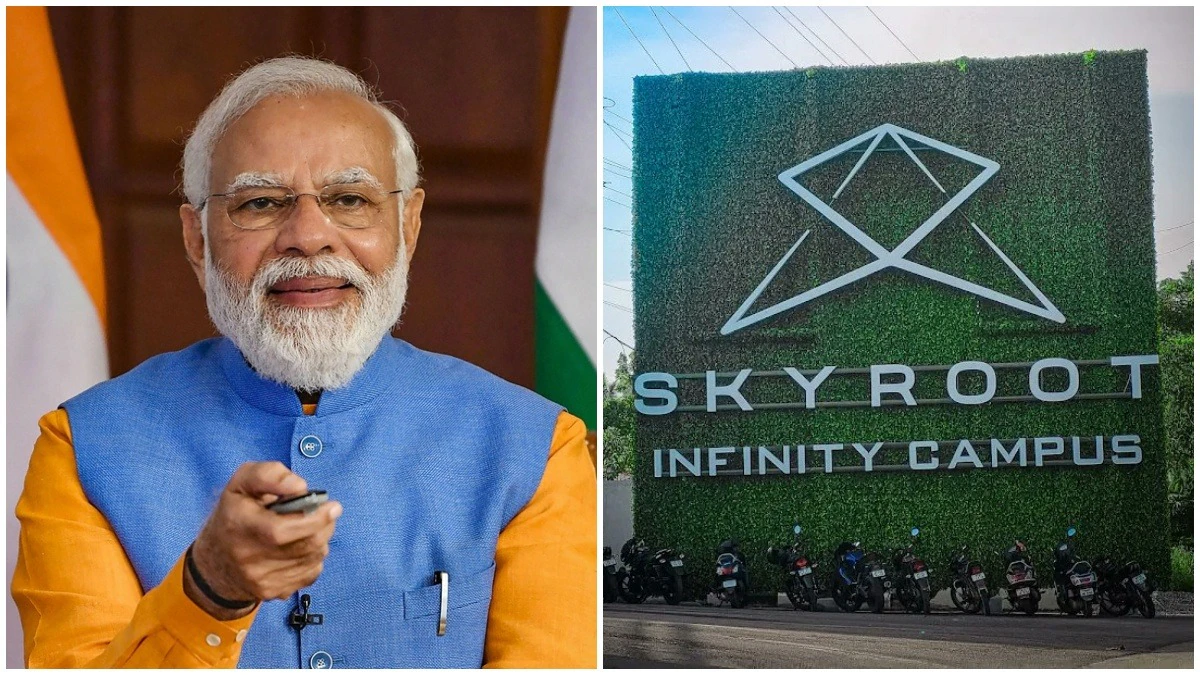
A major leap forward was taken in India’s private space journey on Thursday when Prime Minister Narendra Modi inaugurated Skyroot Infinity Campus, a state-of-the-art rocket manufacturing and integration facility, built by Skyroot Aerospace. The inauguration was done via video conferencing, along with the official unveiling of the company’s first orbital-class launch vehicle, Vikram-I. It is a turning point for the space sector in India, placing it among global leaders in small-satellite launch capabilities.
The Infinity Campus is one of the largest privately-owned aerospace campuses in India, created to support the end-to-end production of launch vehicles under the Vikram rocket series. Situated near Hyderabad, this campus sprawls across several acres and comprises state-of-the-art laboratories, vehicle integration bays, engine test areas, composite manufacturing units, and mission control infrastructure. It is built to global specifications and is said to be capable of producing a fleet of rockets each year, vastly scaling up India’s private launch capability.
Addressing the inaugural event, PM Modi praised Skyroot’s rapid rise and explained how India was turning into an epicenter of global space innovation. He said the future growth of the country would have a strong link with scientific knowledge and private enterprise. “The Infinity Campus represents the potential of India’s youth and the power of our startup ecosystem,” he said. “This is not just a facility-this is a launchpad for India’s leadership in the global space economy.”
The highpoint of the event was the unveiling of the first orbital launch vehicle, christened Vikram-I, developed by Skyroot, which is capable of carrying 300–350 kg of payload to Low-Earth Orbit (LEO). The rocket features a three-stage configuration, solid-fuel propulsion, and advanced carbon-composite structures that reduce overall weight while improving efficiency. For Skyroot’s engineers, Vikram-I will mark a radical departure for India’s fledgling private space industry, which finally offers an efficient and cost-effective way for small-satellite operators around the world.
This development comes after Skyroot had successfully launched Vikram-S in 2022, the first privately developed Indian rocket that made it to space. Since then, the brand has moved from demonstration missions into large-scale R&D and industrial-grade production, joining the front runners in the fast-emerging Indian private space sector. Subject to the completion of testing milestones and regulatory approvals, the first commercial flight for Vikram-I is planned for 2026.
Industry players believe this inauguration sends a strong message out to the world: India is now all set to compete in the commercial launch market. The world has long depended on a few low-cost launch providers, while SpaceX’s rideshare program and Rocket Lab have dominated the small-satellite launches. Skyroot gives India a strategic edge owing to its cost advantages, engineering talent, and government-backed ecosystem that encourages private space innovation.
“Skyroot’s Infinity Campus is a decisive step; now India will be a serious contender for launches of payloads from everywhere,” said a senior space economist, adding that the demand for small satellites in Earth observation, telecommunication, climate monitoring, and defense surveillance is rising sharply, offering a multi-billion-dollar opportunity to launch providers.
Reforms in the space sector by the government, particularly after setting up IN-SPACe, have strengthened the participation of private companies. With access to ISRO facilities, mentorship, and shared testing platforms, startups have accelerated their development cycles. PM Modi reiterated that India’s aim is not just to participate but also to lead in commercial space services.
The top executives of Skyroot thanked the government for this, terming the Infinity Campus the engine that would propel their future missions. They cited scalable manufacturing of rockets at the facility, efficient testing, and rapid payload integration—factors crucial in offering services to a foreign clientele. The campus is designed to accommodate long-term expansion with the addition of new assembly lines and propulsion research wings. The ceremony ended with a virtual walk-through of the facility that will house automated manufacturing systems, mission-control setups, and integration halls where first Vikram-I units will be assembled. The milestone has been welcomed by space enthusiasts and industry leaders as a “historic day for Indian aerospace.” With demand rising globally for small satellite launches, and India pushing ahead with private participation, the inauguration of the Skyroot Infinity Campus marks a new era. It further cements India’s position in the global space value chain and signals that the country is all set to emerge as one of the world’s leading low-cost, high-quality launch service providers.


