


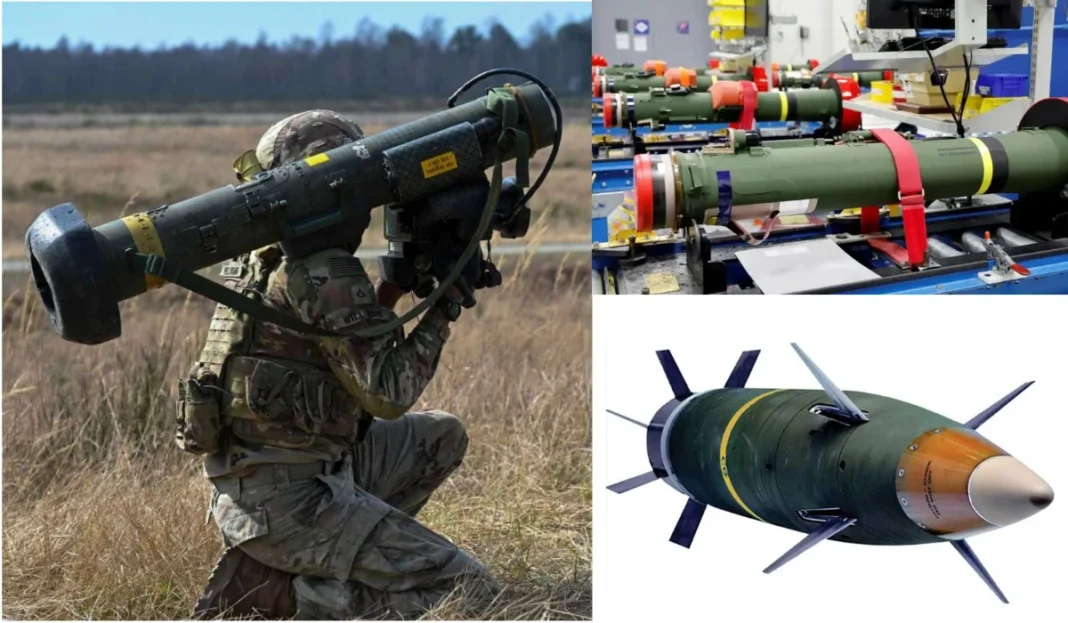
This week, India’s defence partnership with the United States made a critical leap towards completion after Washington approved an almost US$93 million arms sale. The deal involves advanced Javelin missile systems, precision-guided projectiles, and related tactical equipment. This marks yet another milestone in the deepening strategic alignment between the two democracies. Set against a backdrop of evolving regional threats, this agreement carries far-reaching implications for India’s defence preparedness, Indo-Pacific stability, and the future trajectory of the India–US security relationship.
At the heart of this sale is one of the most advanced and battle-tested missile platforms in the world: the Javelin ATGM. With its fire-and-forget technology, tandem warhead, and capability to neutralize both armoured vehicles and fortified structures, the system represents a considerable upgrade of India’s anti-armour capabilities. The US has also included support equipment, training, and logistics components to ensure operational readiness. For India, still in the process of modernizing its infantry and mechanised forces, such advanced systems help bridge capability gaps while guaranteeing interoperability with partner nations.
The sale is strategically well-timed. The Indo-Pacific continues to remain a hotbed of geopolitical tensions, from China’s growing aggressiveness along India’s northern borders to across the South China Sea. While several flashpoints persist, US approval underlines its determination to reinforce India as a counterbalancing power against hostile forces intent on reordering the regional balance of power. For India, too, diversified access to state-of-the-art defense technology strengthens national security while reducing dependence on traditional suppliers.
The deal must also be seen in the context of the evolution of the India-US defence partnership. Over the last decade, the two countries have signed foundational agreements, namely LEMOA, COMCASA and BECA, thereby allowing for deeper cooperation on logistics, secure communications, and geospatial intelligence. Defence trade between the two countries has also grown from nearly zero in 2008 to over $20 billion today. This latest sale is another endorsement of a partnership which is transitioning from a transactional buyer-seller relationship to a more collaborative defense technology ecosystem.
While the sale doesn’t involve direct technology transfer or co-production as of now, defence analysts believe that it sets the stage for future cooperation under the INDUS-X initiative-a joint platform to foster innovation, co-development, and co-production of advanced defence technologies. India’s “Make in India” ambitions also stand to gain as such high-end deals create trust and lead the way for deeper production-level engagements.
Domestically, the buy would have its share of controversies. Critics would tend to cite the costs and advocate for investing more in indigenous missiles like the Nag ATGM and its future MPATGM variants. But the counter-argument has its point: India needs a mix of short-term and long-term solutions. The indigenous systems, promising as they are, are still in the development cycle and trials, while the Javelin system offers immediately deployable and combat-proven capability, something crucial for a nation under active border threats.
The deal also positions India strategically on the global stage through this diplomatically critical bargain. This has demonstrated vigorous US confidence in India as a trusted security partner and works within the broader Quad architecture, where defence cooperation remains one of the key pillars. Support for military modernisation in Washington fits within a larger Indo-Pacific strategy designed to promote a rules-based order while deterring coercive actions by hostile actors. For New Delhi, the partnership aligns with the goal of becoming a leading regional power, capable of defending its sovereignty while contributing to regional stability.
The sale also comes at a time when India is busy recalibrating its defence procurement priorities. With conflicts around the world highlighting the importance of precision weapons, drones, electronic warfare, and tactical mobility, India’s procurement decisions increasingly favour systems that offer rapid deployment and battlefield flexibility. The Javelin’s proven track record in diverse environments-from desert terrains to urban conflict zones-makes it a valuable addition to India’s arsenal. In sum, the newly approved India–US defense deal represents more than a simple military acquisition: it is a strategic investment in regional stability, an indication of the maturing relationship between India and the US, and one step in the modernization process of India’s defense capabilities. As geopolitical uncertainty mounts, partnerships of this nature will prove pivotal to deterrence and national interests. With both countries committed to deeper collaboration, this agreement may only be a precursor to even more ambitious technological cooperation in years to come.


