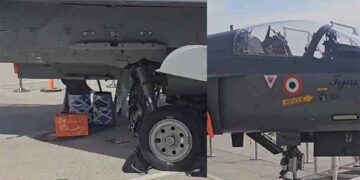


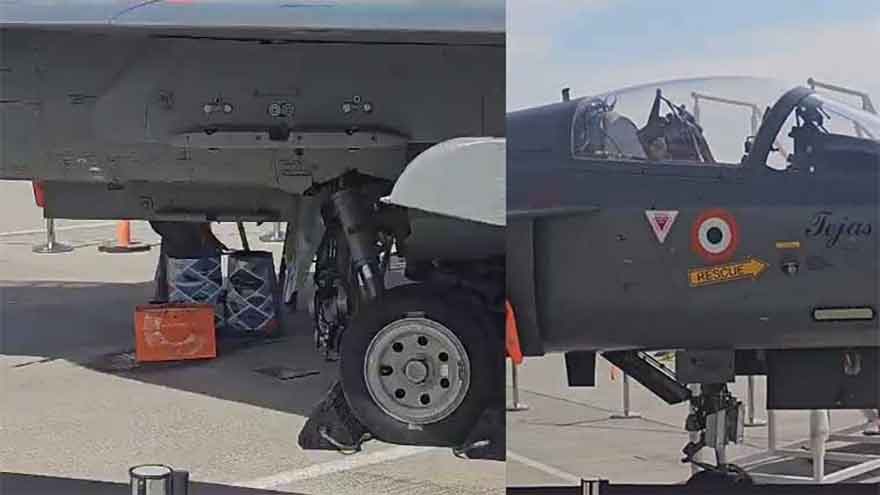
A symbol of India’s progress in aerospace and self-reliance ambitions, the indigenous LCA HAL Tejas, met with a major setback on Friday when it crashed during a high-profile flight demonstration at the Dubai Air Show 2025. The incident, which was viewed by thousands of eyewitnesses, has since kicked off intense scrutiny, raised questions about the reliability of India’s defence aviation programme, and sparked concerns about its impact on export prospects.
The crash happened around 2:10 p.m. local time at the Al Maktoum International Airport, where the air show is being held. According to eyewitness accounts, the aircraft was on a high-speed maneuver when it suddenly lost altitude, tilted acutely, and hit the ground. Within minutes, thick black smoke billowed out from the site of the crash as emergency teams rushed in. Amateur video circulating on social media captured the rapid descent of the aircraft before the impact—already under scrutiny by aviation experts and investigators. As of now, conflicting reports are emerging about the condition of the pilot, while an official confirmation by the IAF is awaited.
The Tejas fighter jet, developed by Hindustan Aeronautics Limited and the Aeronautical Development Agency, signifies India’s decades-long effort to design and produce a combat aircraft of its own rather than depending on foreign suppliers. It is a lightweight, multirole fighter capable of air-defence, reconnaissance, and precision-strike missions. The induction of the aircraft into the IAF has been in phases, with newer variants such as the Tejas Mk-1A promising advanced radar systems, improved avionics, and greater combat versatility. The Tejas programme figures very centrally in India’s long-term vision for defence self-sufficiency under the “Make in India” initiative.
The Dubai Air Show is one of the most influential aerospace exhibitions globally, where global defence manufacturers are present with military delegations and potential aircraft buyers. The participation of India, more so with the showcase of Tejas, was aimed at confidence-building in indigenous platforms and exploration of export opportunities. Countries such as Argentina, the Philippines, and Egypt had shown interest in the aircraft in recent years. However, experts caution that a crash at such a prominent global stage may temporarily dampen interest and slow down the pace of negotiations.
From a purely technical perspective, more questions than answers have been raised so far. Aviation analysts say that demonstration flights are inherently high-risk, as they push the aircraft close to their manoeuvring limits. Investigators will focus on operational factors, pilot inputs, weather conditions, engine performance, and structural integrity to determine the cause. Even a minor technical anomaly at high speed can result in sudden failure. Another important factor will be whether the aircraft that took part was a production article or a prototype, which will determine the possible implications for the overall programme.
This incident comes as the Tejas fleet has been undergoing continuous upgrades. In this context, the delivery of the 83 Tejas Mk-1A jets ordered by the IAF over the next few years underlines the military’s commitment to the platform. Though the aircraft has enjoyed a clean safety record-its previous crash occurred in 2024 during training-the latest incident would surely lead to some sort of temporary review of demonstration procedures, flight safety parameters, and maintenance protocols. Demonstration units may be kept grounded by defence officials until the investigation is complete.
But politically and diplomatically, the crash has wider ramifications. For India, indigenous defence capabilities on the global stage are both a strategic and prestige move. Successive displays build confidence among partner nations and strengthen India’s defence export narrative. A public crash thus raises very valid questions of readiness, quality control, and technological maturity. But experts explain that even advanced fighters from top defence nations have had accidents during air shows, and such incidents must be looked at in the bigger context of military flying.
The reactions in India have been divided. While many are proud of the achievements of the Tejas programme, others have called for a transparent investigation to ascertain gaps in design, training, or execution. According to defence analysts, the long-term prospects for the program are very good, provided the inquiry leads to some constructive improvements. Indigenous defence development is often a slow-moving and complex endeavour, pretty much subject to setbacks before achieving operational maturity. Looking ahead, much depends on the findings of the official inquiry. If the crash is attributed to a technical shortcoming, HAL and ADA may face pressure to accelerate enhancements or revise specific systems. If pilot error or external factors are responsible, training and demonstration rules may be updated. In either case, India will aim to reinforce confidence in Tejas before upcoming international air shows and export pitches. In the end, the Tejas crash at the Dubai Air Show is a major but surmountable setback for India’s aerospace ambitions. While it temporarily impacts perception and raises critical questions, the long-term trajectory of India’s indigenous fighter program will depend on rapid corrective action, transparent investigation, and continued commitment to technological advancement.


