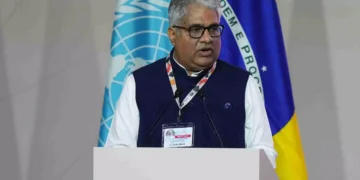


India has said it will delay submission of an updated 2035 climate pledge—its next Nationally Determined Contribution (NDC)—in advance of the COP30 climate summit in Brazil, contending that meaningful progress on global climate goals is impossible without significantly higher financial commitments from developed nations. The move, announced days before the negotiations, underscores deep-rooted tensions between emerging economies and industrialized nations over climate responsibility, equity, and access to funding.
The Ministry of Environment has indicated that while India remains committed to its climate goals under the Paris Agreement, submitting a detailed 2035 target now would be “premature” without clarity on how trillions in global climate finance will be mobilised over the coming decades. India’s position is in line with the wider stance of developing countries, which argue that they cannot chart deep-emission reductions without predictable financial flows-especially for transitioning energy systems, adapting to extreme weather, and building climate-resilient infrastructure.
A Record of Progress, but Coal Remains a Challenge
The delay in its new pledge notwithstanding, India’s climate record over the past decade has been remarkable: it has already achieved a host of components of its 2030 targets in advance. More than 50% of its installed electricity capacity today comes from non-fossil fuels-solar and wind, hydro, and nuclear-an important milestone for the world’s third-biggest emitter.
India is also amongst the world’s fastest-growing renewable energy markets, with ambitious long-term plans for green hydrogen, grid-scale storage, and solar manufacturing. Yet coal remains a dominant part of its energy mix because economic and developmental needs continue to underpin it. The country’s rapid industrialization, population growth, and surging demand for electricity-primarily from manufacturing and commercial sectors-in particular, have continued to fuel coal consumption.
Environmental groups and analysts say India finds itself trapped between two big complex realities-it has achieved huge success in the adoption of clean energy, yet remains fully dependent on coal to meet baseload electricity. A pre-requisite in achieving rapid decarbonization is large-scale financial support for expansion in clean energy and transition of coal-dependent regions.
Climate Finance: India Puts Ball Back in the Court of Developed Nations
India’s move comes amid growing frustration among developing nations over what they see as inadequate climate funding from wealthier countries. Under earlier commitments, developed nations were expected to mobilise US$100 billion per year by 2020 for climate assistance—an amount repeatedly described by economists as vastly insufficient.
India has estimated that it alone would need over US$10 trillion in climate finance by 2070 to reach net-zero emissions. Much of this funding is needed for clean-energy infrastructure, adaptation measures, sustainable mobility, technology transfer, and disaster-resilience.
With richer countries failing to meet past commitments and no consensus yet on a new global climate-finance goal, India has insisted that updated pledges cannot be framed in a vacuum. The country has argued that without clarity on long-term financial flows, developing economies are left with unrealistic and financially burdensome expectations.
Implications ahead of COP30
India’s move is likely to have a ripple effect in Brazil, where climate negotiations are already weighed down by disagreements over global carbon markets, climate-finance architecture, and differentiated responsibilities.
By doing so, India has sent out a strong diplomatic signal: climate ambition has to be matched with climate finance.
Analysts say this might strengthen the negotiating position of other developing nations-particularly those in Asia, Africa, and Latin America-who likewise have argued that climate targets cannot be pursued without adequate funding for clean-energy transitions and infrastructure upgrades.
At the same time, developed nations may view India’s decision as a pressure tactic, citing the fact that India has the capacity to do more intensely in emissions reduction as a rising geopolitical and economic player. Industrialised countries also stress that private financing must play a significant role in the future climate-finance ecosystem, and not just public funds.
Industry and Policy Stakeholders Look for Direction
The delay has drawn a mixed response in India. Clean-energy companies termed the move “pragmatic,” arguing that clarity in the long term on global funding mechanisms is necessary to ensure investment flows into renewables, hydrogen, and electric mobility.
On the other hand, climate-policy analysts warn that without a robust, forward-looking target, India would face the potential for undermining its leadership among developing countries-especially after receiving praise for recent progress in renewable energy. The Road Ahead The message from India is loud and clear: the climate transition of the world cannot be financed by the developing world alone. By COP30, all eyes will be on whether developed countries rise to the challenge with real financial commitments—and whether India leverages that momentum to announce an ambitious, actionable 2035 climate pledge that further cements its status as a global climate leader.


