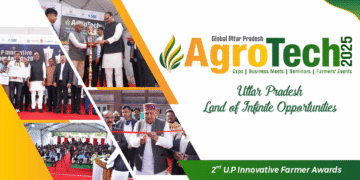


The country’s most populous state, Uttar Pradesh, is increasing its focus on agriculture as the bedrock of economic growth, rural development, and export potential. UP has fertile plains, vast tracts of cultivable land, and a large farming population, putting it at the forefront of leading India’s agricultural transformation. The state envisions not only improving farmers’ incomes but also emerging as a global agricultural leader by 2047 through ambitious initiatives, adoption of modern technology, and long-term policy planning.
The “Viksit UP @ 2047” vision lies at the core of the strategy of the state. This road map lays out the transformation needed within the next two decades in agriculture, its infrastructure, and rural development. It envisions the state’s aim to be the top-ranking state in India for crop productivity and agricultural exports by 2030, and to compete with major global agricultural powers like the U.S., France, and Australia by 2047. The vision emphasizes sustainable growth, technological modernization, and value addition to farm produce, signifying a shift from subsistence agriculture to one that is market-oriented and export-ready.
In all, the plan has targeted six strategic areas comprising enhanced storage and value addition through cold chains and food parks, construction of processing infrastructure, research and innovation in agriculture, sustainable and scientific farming, diversification of crops to spread risk and improve profitability, and strengthening institutional support through FPOs and commodity boards.
Technology-Driven Modernization
UP is promoting digital and technology-driven farming to enhance efficiency and improve profitability. The state is also working with agritech companies and international bodies like the World Economic Forum to develop a DAEP. It aims at promoting the adoption of precision farming, soil health monitoring, and better irrigation techniques. Export-oriented clusters would be created for high-value crops like mangoes, potatoes, spices, and horticultural produce.
The UP-AGREES project, for climate-resilient agriculture, better irrigation, access to credit through digital platforms, and low-emission farming techniques, is supported with an investment of $325 million by the World Bank. Under this program, it is expected that a large number of small and marginal farmers will benefit, along with much training for capacity building in order to ensure the adoption of modern techniques.
Infrastructure for Growth
Basic infrastructure is at the core of UP’s aspiration to emerge as the country’s leading State in agriculture. Export facilities are being developed near Jewar Airport in Noida, facilitating direct air consignment of high-value horticulture crops. Mega food parks and processing units are proposed for facilitating value addition with reduced post-harvest losses. Huge investments have been made in irrigation over recent years: through 29 major, medium, and minor irrigation projects built in the last eight years, its coverage area has expanded to 19.11 lakh hectares and ensured water availability for critical crops.
The UP government is also encouraging the formation of commodity boards on specific crops, along the lines of the Spices Board at the national level, for commodities such as mangoes, potatoes, and flowers. Such boards are likely to integrate production, quality control, marketing, and export processes in order to grant farmers access to better markets and improve their incomes.
Economic and Social Impact
Agriculture continues to be one of the mainstays of the UP economy. In 2023–24, it accounted for about 16.8% of the state’s GDP, against 13.7% in the previous period. Pro-farmer reforms such as digital mandi, e-licensing, and real-time market prices introduced efficiency and transparency into the system. Organic farming and natural methods of cultivation have started taking root in regions like Bundelkhand, with this practice contributing not only to environmental conservation but also to the health of the farmers.
Challenges Ahead
While the vision is ambitious, several challenges must be addressed. Large financing against massive infrastructure projects, modern technology adoption at scale, environmental sustainability, and strong market linkages for export are required. Most importantly, small and marginal farmers’ alignment with technological and policy initiatives will demand continuous outreach and training. Conclusion Renewal of focus on agriculture in Uttar Pradesh constitutes an ambition of transforming the sector from a traditional livelihood into a globally competitive, high-income engine. The Viksit UP 2047 vision is to consolidate its positioning in both national and global agricultural markets through improvement in farmers’ incomes and strengthening rural economies, with increased technology adoption, reforming policy, and substantial infrastructure investments. With effective execution, UP could become a model for agricultural development in India and beyond, shaping the future of Indian farming for decades to come.


