


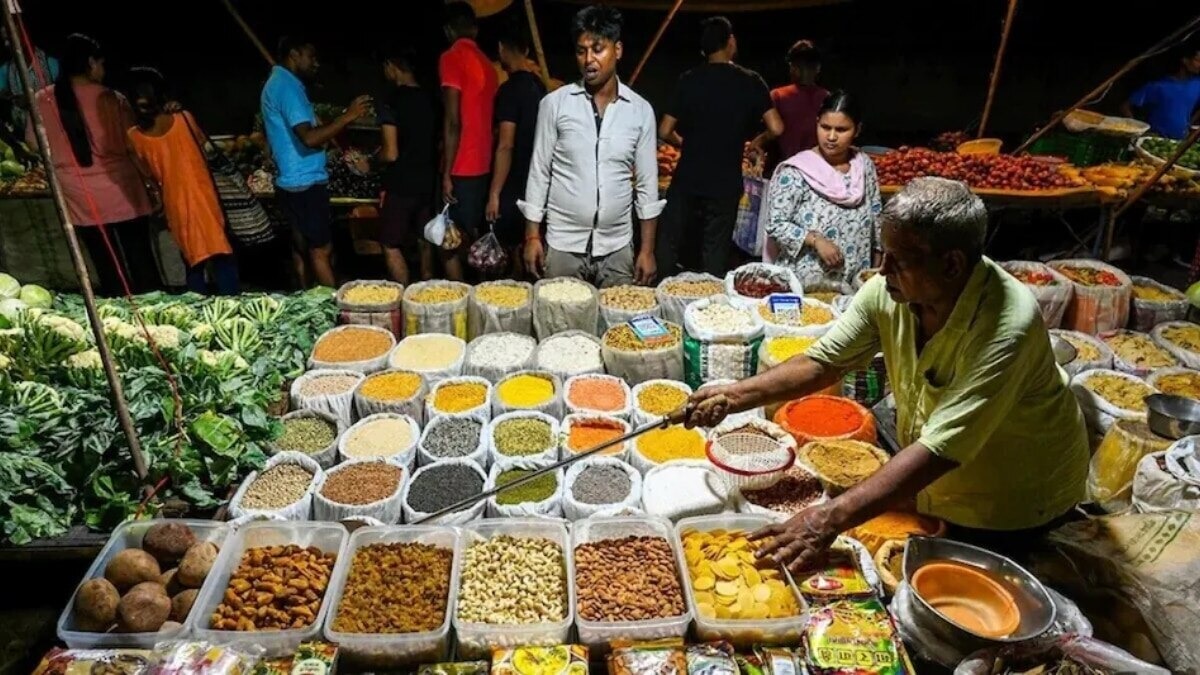
In October 2025, India’s retail inflation has come down to a historic low of 0.25%, which is the lowest since official consumer price tracking began. Driven mainly by cooling food prices, a strong rupee, and a reduced burden of indirect taxes, this sharp decline further fueled expectations that the RBI might cut rates in an upcoming monetary policy meeting in December, aimed at speeding up growth and liquidity in the economy.
Food Prices Drive Deflationary Trend
The largest contributor to the inflation slide has been the sharp fall in food prices, which make up nearly half of India’s Consumer Price Index (CPI) basket. Prices of vegetables, cereals, and pulses fell between 8-12% in October after months of bumper harvests and government-led supply interventions.
Data from the Ministry of Consumer Affairs showed retail onion prices have fallen more than 30%, while wheat and rice prices have moderated around 10% compared to the last quarter. On the other hand, the prices of edible oil — one of the major components of inflation — have stabilized due to recovery in global supplies and cuts in import tariffs.
Economists attribute these developments to a mix of favorable monsoon distribution, improved logistics related to agriculture, and the government’s targeted subsidy programs. “We are in the most benign food inflation cycle in over a decade,” said Dr. Ritu Anand, chief economist at DBS India. “The moderation is broad-based and not limited to any single category.”
Core Inflation Also Cools
Though headline inflation is often distorted by volatile food prices, core inflation, which excludes food and fuel, is actually showing a cooling that provides an encouraging sign for policymakers. At 2.1%, core inflation was the lowest in over seven years, pointing to softer price pressures in housing, healthcare, and consumer goods.
Manufacturers have benefited from easing input costs, as global commodity prices-particularly oil and metals-have softened. Along with a stable rupee and declining import costs, the overall inflation environment has become unusually calm.
The rate cut also aligns with the tight monetary stance of the RBI since 2023, when it started aggressively raising rates to combat post-pandemic price spikes. Now, analysts believe the central bank has ample room to pivot toward monetary easing.
RBI’s Next Move: Rate Cut on the Horizon?
With inflation well below the RBI’s 4% target, markets are increasingly betting on a December rate cut. Anticipatory falls in government bond yields and a modest strengthening of the rupee against the dollar reflect expectations of foreign investors of renewed monetary support for growth.
“India’s inflation trajectory presents an ideal window for the RBI to cut policy rates by at least 25 basis points,” said Madan Sabnavis, Chief Economist at Bank of Baroda. “It would provide relief for borrowers, encourage investment, and support consumer sentiment going into 2026.”
However, not all economists would want one to cheer just as yet. They say the global environment continues to remain uncertain amidst the turmoil in oil markets and the impact of El Nino on food production in 2026. “While the data supports easing, the RBI must remain cautious to avoid reigniting inflationary pressures,” warned Priya Nair, economist at ICICI Securities.
Government Welcomes Data, Focuses on Growth
The central government has hailed the lower inflation number as a vindication of its fiscal discipline and supply side reforms. According to the Finance Ministry, this was a result of ‘timely interventions-e.g., cuts in GST rates, reduction of import duties on essential commodities, and efficient warehousing and logistics arrangements that reined in supply bottlenecks’.
“Lower inflation translates directly into more purchasing power for the middle class and rural consumers,” Finance Minister Nirmala Sitharaman said in a statement. “Our next priority is to ensure that the benefits of price stability translate into job creation and higher growth.”
It is also considering an expansion of the Rural Consumption Revival Program in order to shore up demand in semi-urban and farm areas that were affected by slow wage increases.
Consequences on Businesses and Consumers
If the RBI actually cuts the rates in December, it would be a signal that monetary policy is shifting towards growth support. Lower interest rates would lower borrowing costs for businesses and homebuyers, and this could spur real estate, automobile, and infrastructure sectors.
Lower inflation is already showing up for consumers — items such as food, fuel, and clothing have become less expensive, easing household budgets. For exporters, a strengthening rupee may challenge the goods they make at home and sell internationally, meaning the outlook isn’t uniformly upbeat across sectors.
Stock markets have reacted well, with the Nifty 50 index up 1.3% since the inflation announcement, driven by banking and consumer goods stocks.
Outlook: Stable with Caution While this record-low inflation is a milestone for India’s macroeconomic stability, economists warn that it may not last. The challenge now is how to sustain this low-inflation environment without undermining growth momentum or fiscal prudence. If well managed, this could be India’s “Goldilocks moment” of low inflation, stable currency, and strong growth potential. However, for that, policymaking would have to play a careful balancing act between optimism and vigilance, as global commodity cycles, climate variability, and geopolitical uncertainties continue to shape the economic landscape.


