


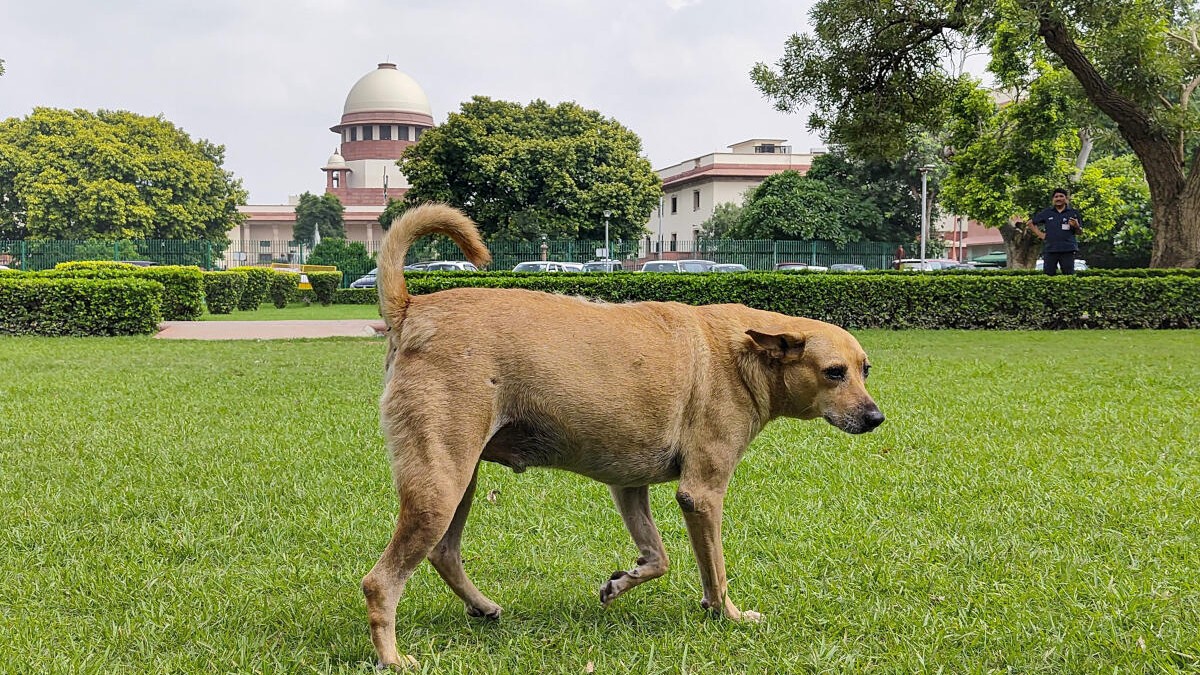
In a landmark development, the Supreme Court has stepped up its vigil over stray dog management in states and Union Territories, threatening strict action against states failing to comply with the courts’ directions. What originated from the suo motu case In Re: City Hounded by Strays, Kids Pay the Price has turned into a national debate about a judicious balance between animal welfare and public safety.
The case was filed based on alarming reports regarding increasing cases of dog bites and deaths due to rabies, especially among children. The top court had previously expanded the scope of its orders beyond Delhi-NCR to all Indian states under the Animal Birth Control (Free-Roaming Dogs) Rules, 2023. The judgment passed in August 2025 ordered the states to capture, sterilize, vaccinate, and deworm stray dogs while also stating that unregulated feeding of stray dogs in public must stop immediately.
However, several months thereafter, most states did not show any signs of improvement. The apex court, therefore, on 27 October 2025, voiced severe displeasure over this and summoned the Chief Secretaries of all non-compliant states and UTs to appear in person before it on 3 November. The Court refused virtual appearances, stating that lack of seriousness in following orders would not be taken lightly. “This is not a matter to be taken lightly,” the bench observed, while underlining the urgency of implementing humane yet efficient measures to deal with the stray dog menace.
When the matter was heard on 3 November, multiple Chief Secretaries appeared before the bench and tendered unconditional apologies for their failure to file compliance reports. The Court, while accepting the apologies, made it clear that continued negligence would invite stricter judicial measures. The next hearing will take place on 7 November 2025, when the Supreme Court is expected to issue comprehensive directions regarding the practice of feeding and sheltering with particular emphasis on public institutions and government premises.
The firm stand of the Court, however, is based on the increasing public health menace created by stray dogs. Thousands of dog-bite cases are recorded every year in India, and incidents of rabies transmission often raise alarms. The apex court, time and again, emphasizes that there is a dire need for organized sterilization, vaccination, and sheltering under the ABC Rules, 2023. These rules strive to ensure that the population control mechanism is carried out with due respect for the animal’s life, avoiding mass killing, which remains illegal under Indian law.
At the same time, the case reveals a developing tension between animal welfare activists and public safety advocates. While some NGOs have argued that stray dogs should be allowed to continue as part of community life, several citizens’ groups have demanded more stringent containment measures in high-density urban zones. The Court’s directions seek a balance between compassion and caution in calling for regulated feeding zones, municipal shelters, and coordination between local bodies and animal-welfare boards.
The Supreme Court has also warned individuals or organizations impeding the work of authorized dog-catching or sterilization, mentioning that such obstruction may invite penal provisions. Municipal corporations, housing societies, and public institutions have been asked to bring their local rules in tune with state and national policies. Government offices, PSUs, and large campuses may also be made to establish feeding zones and ensure reporting of dog-bite cases on a regular basis.
The case carries significant implications beyond animal welfare. For urban governance, it underlines the deficiencies in infrastructure and coordination among civic bodies. Indeed, the demand of the Court for detailed affidavits to be furnished, ranging from a count of the number of dogs sterilized and shelters available to statistics on dog bites and budgets allocated for animal control, highlights how fragmented municipal systems are across states.
The business ripples would be from stalled or postponed projects in various sectors: large venues will need to institute formal animal management policies to avoid falling foul of the law and mitigate liability risks, as well as real estate projects and educational institutions. On the other hand, this situation opens new opportunities: for example, startups and civic-tech platforms may develop data-driven solutions for monitoring stray-dog populations, tracking vaccinations, and coordinating sterilization drives.
Public opinion continues to remain divided, with calls by many citizens for strict containment, while animal rights groups insist on humane and lawful approaches. What is certain, however, is that unauthorized feeding and a surge in stray populations create increasing problems for governance and community safety. With the country waiting for the Court’s final order on 7 November 2025, the result could redefine how India looks upon its street-dog population-not only as a question of compassion but as one of policy, accountability, and urban responsibility. Active intervention by the Supreme Court signals that the era of neglect is over; states must now implement tangible measures or face legal consequences. Ultimately, this case could be the tipping point that changes how India balances animal rights with public welfare and sets a precedent for humane yet firm governance in handling one of the country’s most visible civic challenges.


