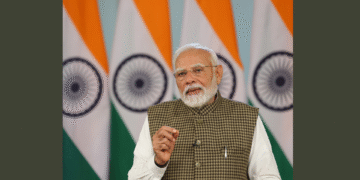


Prime Minister Narendra Modi has sent a clear and powerful message on India’s fight against left-wing extremism, asserting that the days of Maoist violence are numbered. Speaking at a public event in Chhattisgarh, the Prime Minister expressed satisfaction over the significant decline in Naxal activities and reiterated his government’s commitment to eradicating the remaining traces of insurgency from the country. His remarks come at a time when internal security data shows that only a handful of districts continue to report Naxal-related incidents — a stark contrast to the widespread violence of previous decades.
Naxal Footprint at Historic Low
The Prime Minister pointed out that of the 125 districts earlier badly affected by Maoist insurgency, Naxal presence is now reported to be significant in only three districts. This, he explained, is the success of the government’s multi-pronged strategy relating to security operations, development initiatives, and community engagement.
Over the past decade, a blend of spirited counter-insurgency operations, adequate intelligence sharing, and focused development programs in tribal areas has produced visible dividends. The MHA has also developed road networks, improved mobile connectivity, and tightened local governance mechanisms in regions earlier held by Maoist groups.
Today, we can proudly say that the red shadow that once loomed large over India’s forests and villages has been reduced to just a few pockets. Our security forces have shown extraordinary courage, and our development approach has ensured that the youth are now choosing progress over violence.
A Shift from Fear to Development
PM Modi’s speech highlighted the fact that the government’s mission is not only to win a military victory; the attempt was to change the socio-economic realities that once fueled extremism. “We are turning the red zones into growth zones,” he said, underlining efforts by the central government to bring roads, electricity, healthcare, and education to the tribal and remote areas that were long neglected.
Experts note that this dual approach — security plus development — has been the cornerstone of India’s anti-Naxal strategy in recent years. The government’s “Aspirational Districts Programme,” which prioritizes backward and conflict-affected regions for special funding and monitoring, has brought tangible improvements. In several former Maoist strongholds like Dantewada and Sukma, young people are now joining vocational training programs and start-ups instead of militant groups.
Role of Security Forces
The PM also paid homage to the soldiers, police personnel and the paramilitary men who lost their lives in counter-insurgency operations. He praised CRPF, BSF, and other central as well as state forces for their tireless efforts in pursuit of peace in Maoist-dominated regions.
According to the latest government data, incidents of Naxal violence have declined by nearly 80% since 2014, and fatalities among security personnel are at their lowest in decades. Several top Maoist commanders have surrendered, while others have been neutralized in targeted encounters. “Our brave men and women in uniform have not only fought the extremists but have won the trust of the people,” Modi said.
Political and Strategic Implications
Modi’s message, therefore, also held political significance-just months into the assembly elections due in Chhattisgarh, a state that has long been at the heart of the Maoist conflict. His remarks are acts of reassurance to citizens of the government’s achievements in security matters and serve as subtle reminders of how far the region has come under BJP-led administrations.
For political analysts, this is part of the bigger national narrative: projecting Modi’s government both as strong on security and sensitive to grass-roots development. The Prime Minister’s statement also furthers India’s international image as a country that has successfully tackled one of the world’s longest-running insurgencies without large-scale outside intervention.
Challenges Ahead
Despite the optimism, experts caution that the fight is not over. Some residual Maoist groups remain active in parts of Bastar (Chhattisgarh), Gadchiroli (Maharashtra), and a few border regions of Odisha and Jharkhand. These groups continue to exploit local grievances, land disputes, and governance gaps to maintain influence. The government’s challenge now lies in ensuring that the development process is inclusive and sustainable, preventing a resurgence of discontent.
In addition, with the decline of Maoist influence, illegal mining, corruption of local governance, and environmental degradation may be some of the new challenges that these areas could face. Development linked to ecological balance remains crucial in ensuring sustained peace.
The Road to a Naxal-Free India PM Modi concluded his speech with an assurance of real steel: “The day is not far when every corner of Chhattisgarh-and every corner of India-will be free from the shadow of Maoist terror.” His remarks betray both a declaration of victory and also a reminder of the unfinished nature of the mission. The message was clear as India struck back at its Naxal-affected regions with roads, schools, and jobs: the era of fear is ending; a new chapter of peace and progress has begun, the Prime Minister announced.


