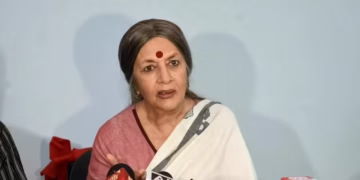


In a major political news, the opposition combine under the INDIA bloc has shown fresh solidarity in Bihar, as reports of internal conflicts continue to plague the ruling National Democratic Alliance (NDA). The recent comments made by senior Communist Party of India (Marxist) leader Brinda Karat have given a fresh boost to the opposition’s story of unity and purpose, contrasted sharply with what she referred to as the “fragmented and power-oriented” politics of the ruling alliance.
At a meeting in Patna, Brinda Karat claimed that the solidarity of the INDIA bloc was the result of its common vision of restoring democratic principles, fighting unemployment, and opposing communal polarisation. “We come from different parties, but our aim is one — to save the Constitution and the essence of secularism,” she declared. Her comments coincided with the time when tensions between the NDA, more specifically between the Bharatiya Janata Party (BJP) and the Janata Dal (United) [JD(U)], seem to be increasing.
Cracks Within the NDA
Political observers say that the NDA’s recent woes in Bihar are mainly due to disagreement on seat-sharing and leadership positions prior to the next elections. Even though Chief Minister Nitish Kumar’s JD(U) has been a long-standing NDA ally, his changing position on national matters and repeated criticism of central policies have made BJP leaders in the state nervous.
Some local reports indicate that the smaller NDA allies, such as factions of the Lok Janshakti Party (LJP), are discontent with the BJP’s control over alliance decisions. The return of Chirag Paswan’s faction, which still contests Nitish Kumar’s leadership, has made the rift even more pronounced.
This unrest within has provided the opposition with a chance to pose as a stable, unified force — something that Bihar politics has not seen in years.
The INDIA Bloc’s New Momentum
The Opposition front, which includes the Rashtriya Janata Dal (RJD), Congress, Left, and some regional parties, is trying to firm up its hold in the districts of Bihar. RJD leader Tejashwi Yadav has been at the forefront in uniting the anti-NDA mood, emphasizing in his speeches the issues of youth joblessness, growing prices, and farmers’ distress.
Recent joint rallies organized by the INDIA bloc have drawn big crowds, pointing towards public disillusionment with governance, inflation, and job generation having a potential impact on the election mood. Top leaders have also started making moves for a detailed campaign strategy, underlining social welfare, inclusive governance, and defense of constitutional institutions.
Brinda Karat’s insistence on “unity through purpose” has struck a chord among a wide chunk of the electorate, especially among rural laborers and students who are aggrieved by feeling themselves left out of Bihar’s development narrative. “People are sick of empty rhetoric and headline politics,” she said, highlighting the opposition’s bid to reposition the agenda from ideology-based conflicts to issue-based governance.
Bihar’s Political Balancing Act
In the past, Bihar has had a pivotal role in determining national politics. From the JP movement of the 1970s to the Mandal period and beyond, it has served as an experimentarium of political experimentation and realignments of alliances. The electorate of the state is extremely sensitive to coalition politics, caste mathematics, and performance-oriented campaigning.
If the INDIA bloc manages to maintain its unity, it could challenge the NDA’s long-standing dominance in the state. However, the alliance’s success depends heavily on resolving internal seat-sharing disputes and presenting a clear, collective vision to voters.
The BJP, on its part, is intensifying its grassroots outreach to counter the opposition narrative. Party leaders have been holding coordination meetings and announcing welfare measures aimed at rural households. The BJP’s focus remains on projecting Prime Minister Narendra Modi’s leadership as the anchor of stability and progress, even as state-level tensions persist.
The Road Ahead
With Bihar approaching a high-pitched poll, both coalitions are at the make-or-break point. For the NDA, regaining intra-ally harmony and presenting a common campaign front will be the tickets to staying in power. For the INDIA alliance, maintaining its newfound cohesion and translating it into poll momentum is the true challenge.
Experts think the next few months will decide if Bihar remains in the leadership of NDA or experiences political realignment under the forces of opposition. Either possibility, however, has the state back in the forefront of India’s changing political story — an indication of its long-lasting hold and the changing tides of national politics.


