


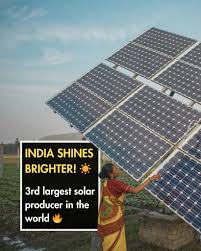
India has made a big clean energy milestone by emerging as the third-largest solar power producer in the world, as per the International Solar Alliance (ISA) and the Ministry of New and Renewable Energy (MNRE). The revelation is a landmark movement in India’s effort to spearhead the world towards renewable energy and cut down on the use of fossil fuels.
Union Coal and Renewable Energy Minister Pralhad Joshi hailed the milestone, pointing out that India’s solar power journey is not just a technological leap but also a cultural change towards sustainable living. “India’s solar revolution is driven by innovation and intent,” he said, pointing out that almost 50% of the nation’s overall installed energy capacity now comes from solar and other clean sources.
A Decade of Rapid Growth
India has experienced one of the world’s fastest expansions in renewable energy in the last decade. The country had installed solar capacity of less than 3 GW in 2014 but now has over 85 GW—a ratio increase by nearly 30 times. It is driven by large solar parks, rooftop solar programs, and robust policy backing from the government under initiatives like the National Solar Mission and PM-KUSUM scheme (for farmers’ solar installations).
As per ISA statistics, the world’s top three solar power producers are China, followed by the United States and India, which has usurped the third position from Japan and Germany. India’s stable investment in solar technology, infrastructure, and global cooperation is identified as the prime reason for this success in the report.
Flagship Projects Lighting the Way
India’s solar success story rests on the shoulders of some path-breaking projects. The Rajasthan’s Bhadla Solar Park is still one of the world’s biggest solar power facilities, covering an area of 14,000 acres and producing 2,245 MW of pure electricity. In the same vein, states such as Gujarat, Tamil Nadu, Karnataka, and Madhya Pradesh have become hubs for renewable energy, making huge contributions to the national grid.
Rooftop solar adoption has also surged, especially in urban areas and industrial zones. The government’s ‘Solar Rooftop Phase II’ program aims to achieve 40 GW of rooftop capacity by 2026, offering subsidies and incentives for households and small businesses to install solar panels.
Global Partnerships and Green Diplomacy
India’s solar growth is also made possible by robust international partnerships. As a founding member of the International Solar Alliance (ISA)—a program initiated in partnership with France in 2015 at the Paris Climate Conference—India has emerged as a green diplomacy champion. The ISA now has more than 120 member nations, whose combined efforts are aimed at mobilizing investment and spreading best practices for solar uptake.
Further, India has collaborated with prominent economies such as Japan, Germany, and the UAE for augmenting solar technology transfer, funding, and infrastructure development. Another strategic step towards avoiding import dependence and stimulating local industry is the government’s Production-Linked Incentive (PLI) scheme for local solar module manufacturing.
Environmental and Economic Impact
The expansion in solar power generation has had a far-reaching influence on India’s economy and climate. Solar projects, according to the MNRE, have cumulatively assisted in reducing over 200 million tonnes of CO₂ emissions every year, playing a major role in contributing to India’s climate targets.
In addition, the renewable energy industry has emerged as a major driver of jobs, creating almost 200,000 direct employment opportunities and supporting millions in construction, maintenance, and ancillary sectors. The transition has also alleviated India’s exposure to oil price shocks from abroad, enhancing energy security.
Challenges and the Road Ahead
Whereas the unprecedented advancement is undeniable, issues still persist. Grid integration, land procurement, and storage facilities are still areas for improvement. Experts advise that if India hopes to achieve its 500 GW renewable energy goal by 2030, emphasis on battery storage systems, smart grids, and hybrid (solar-wind) projects will be critical.
There is also an increasing requirement for bridging financing gaps, especially for small developers and rooftop solar consumers. The government has been trying to reduce approval procedures and encourage smooth access to green financing with public and private banks.
Toward a Sustainable Future
India’s status as the world’s third-largest solar power generator is more than a figure—it is a testament to the country’s dedication to sustainability, innovation, and global leadership on climate action. The country’s achievement is proof that big and widespread clean energy adoption is possible in emerging economies with the right combination of policy, participation, and persistence.
As India continues to expand its solar horizons, the vision of “One Sun, One World, One Grid” proposed by Prime Minister Narendra Modi aims to connect nations through a transnational solar energy network—ensuring that sunlight, the most democratic source of power, becomes a shared global asset.
With the sun as its ally and innovation as its guide, India’s solar story is set to shine even brighter in the decade ahead.


