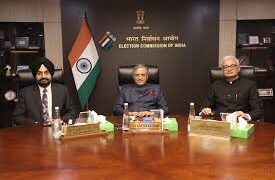


New Delhi, October 27, 2025 — The Election Commission of India (ECI) will stage a large press conference this evening to announce a countrywide effort to deepen voter registration, expand the accuracy of data, and clean up the overall integrity of the electoral rolls of India. The decision comes prior to the crucial state elections scheduled in early 2026 and the approach to the 2029 general elections, marking the Commission’s new focus on clean, transparent, and inclusive polling practices.
One of the key announcements, according to official sources, will center on the announcement of a Pan-India Special Intensive Revision (SIR) of electoral rolls. This exercise will be carried out in all states and union territories so that every eligible citizen is correctly enrolled and outdated, duplicate, or incorrect entries are done away with. The exercise will also aim to make voter registration easier, particularly for youth and first-time voters, and enhance the accessibility of voter services via digital means.
The press briefing by the ECI is likely to be headed by Chief Election Commissioner Rajiv Kumar, accompanied by Election Commissioners Gyanesh Kumar and Sukhbir Singh Sandhu. The Commission will likely release detailed instructions for state election authorities and Booth-Level Officers (BLOs), such as the schedule and procedure for revising the list.
Strengthening Electoral Integrity
Officials privy to the development indicate that the ECI plans to bring in new verification procedures that use technology to identify discrepancies in voter rolls. The role of Artificial Intelligence and machine learning technologies is anticipated to be integrated to check for consistency in data between several government databases like Aadhaar, PAN, and driving licenses.
This is a move towards data-driven election administration, which the Commission has been increasingly embracing in recent years. Through embedding AI-facilitated data validation, the ECI seeks to substantially cut duplication, impersonation, and inaccuracies in voter rolls—issues plaguing India’s massive electoral process for years.
Volunteer-Based Outreach in Focus
One of the strongest points of emphasis in today’s announcement will be to seek the appointment of volunteers to complement Booth-Level Officers (BLOs) during the voter verification and awareness campaign. This will be a very important initiative in states such as West Bengal, Bihar, and Uttar Pradesh, where voting turnout and enrollment accuracy have traditionally proven difficult because of geographical and demographic intricacies.
These volunteers—a combination of teachers, students from colleges, and members of civic bodies at the local level—will serve as grass-roots ambassadors, assisting citizens to cross-check their names in the rolls and motivating them to register online through the National Voter Service Portal (NVSP).
Sources show that the Election Commission has also approached NGOs and youth groups to collaborate on voter literacy and civic engagement through local programs, with particular emphasis on women, differently-abled citizens, and migrant workers, who are often denied registration.
Transparency and Accountability
The Election Commission’s soon-to-be-held briefing is being seen as an effort to further ensure transparency and accountability in the electoral process amidst increasing international scrutiny of electoral integrity. The world has recently discussed disinformation about elections, misuse of artificial intelligence, and voter manipulation, compelling democracies like India to make their systems more robust against cyber and data attacks.
In this regard, the Commission can also announce improved cybersecurity features of its digital voter platforms and internal network. With India’s largest voters roll, the world’s largest with more than 96 crore registered voters, data security is becoming a matter of importance day by day.
Precursor to Election Year Preparations
The timing of the announcement is also significant. A number of states, such as West Bengal, Haryana, and Maharashtra, are set to go for polls in the year 2026. The thorough revision and digitalization of electoral rolls will thus be the basis for conducting forthcoming elections in a smooth and credible manner.
The Commission will also probably indicate its election preparedness audit roadmap, polling station improvements, and inclusion schemes.
Specifically, there is increasing curiosity as to how the ECI intends to increase the use of postal ballots and remote voting technology for domestic migrants—a topic being tested on a pilot basis in some areas.
Public Expectation and Political Reaction
Political experts aver the ECI briefing could be one of its biggest administrative overhauls since the 2024 general elections. “This is not procedural revision—it’s an effort to update the very bedrock of India’s democracy,” averred a senior election policy researcher at the Centre for Electoral Studies.
Political parties have largely welcomed the initiative, although some opposition leaders have called for greater transparency in how voter data is verified and deleted. The ruling government, meanwhile, has praised the ECI’s use of technology and volunteer engagement as steps toward achieving a more participatory democracy.
As the country waits with bated breath for the formal announcement later tonight, everyone looks towards the Election Commission to find out how it plans to strike a balance between innovation and inclusiveness—making sure that India’s democratic machinery stays strong and representative.


