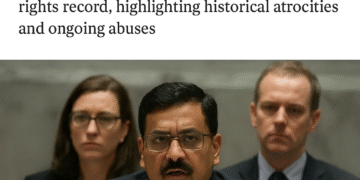


Making a scathing speech at the United Nations Security Council (UNSC) on October 7, 2025, India strongly condemned Pakistan’s track record with regard to women’s rights, calling Pakistan’s recent statement with regard to Jammu and Kashmir a “delusional tirade.” The remarks were made in an Open Debate on Women, Peace, and Security, where Pakistan had complained about the alleged plight of Kashmiri women. India’s Permanent Representative to the UN, Ambassador Parvathaneni Harish, replied by pointing to Pakistan’s own record of atrocities against human rights.
History of Atrocities in 1971
Ambassador Harish drew attention to Pakistani actions throughout the 1971 Bangladesh Liberation War, in particular Operation Searchlight, where Pakistani forces were accused of inflicting mass atrocities, including the systematic rape of as many as 400,000 women. He referred to such acts as a “sanctioned genocidal mass rape,” highlighting that such past violations negate Pakistan’s credibility when it comes to talking about women’s rights.
Pakistan’s Current Human Rights Record
India also referred to continuing human rights abuses in Pakistan, such as the mistreatment of minorities and the employment of gender-based violence as a weapon of war. Ambassador Harish made it clear that Pakistan’s efforts to shift international focus away from its own track record by “misdirection and hyperbole” were clear and unimpressive.
India’s Commitment to Women’s Rights
Conversely, India reiterated its support for women’s rights and peacekeeping. Ambassador Harish pointed out India’s leadership in the Women, Peace, and Security agenda by stressing that India was one of the earliest nations to send women medical officers on UN peacekeeping missions in the 1960s. He emphasized that India’s record is “unblemished and unscathed.”
International Reactions
The global community has generally stood in favor of India’s position, recognizing the necessity for accountability and substantive dialogue about women’s rights issues. As Pakistan continues to complain about Kashmir, India’s reaction highlights the necessity for dealing with past and current human rights abuses in a positive way.
India’s firm denunciation of Pakistan’s statement at the UNSC is a reminder of the intricacies involved in debating women’s rights in conflict situations. While bringing to light the plight of women is the need of the hour, it is just as crucial to discuss and address the foundational causes of this plight, such as historical grievances and current human rights violations. India’s call for accountability and serious dialogue is a precedent that could be followed in any discussion on women’s rights on the international stage.


