


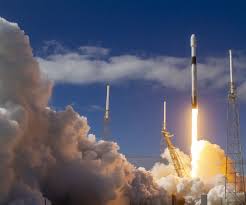
SpaceX launched a Falcon 9 rocket from Florida’s Cape Canaveral on October 4, 2025, sending 60 Starlink internet satellites to low Earth orbit. The flight represents the company’s 82nd Starlink launch and continues to grow its satellite internet constellation to enable global broadband reach, particularly to remote and underserved areas.
The liftoff took place at 9:12 PM IST, with the Falcon 9 taking off under clear sky conditions. The rocket’s first stage quickly carried out a perfect landing on SpaceX’s autonomous drone ship located in the Atlantic Ocean. The precision landing is the company’s latest achievement in reusing boosters, which lowers the cost of satellite deployment considerably.
After reaching orbit, the 60 Starlink satellites deployed as planned, adding to SpaceX’s expanding constellation of more than 6,000 satellites. The satellites will offer fast internet with little latency to customers across the globe. Elon Musk, SpaceX CEO, celebrated the success on X (formerly Twitter), posting, “Another successful launch! Starlink continues to expand access to reliable internet globally.”
The newest set of satellites includes improvements in power efficiency and signal processing, improving coverage and speed for clients. SpaceX has been working toward constant upgrades of its constellation to ensure congestion is tackled and quality of service is high. Experts indicate that with every new launch, SpaceX becomes more competitive against other satellite internet companies like OneWeb and Amazon’s Project Kuiper.
World telecom experts are looking at SpaceX’s Starlink expansion as a possible game-changer for areas that have poor infrastructure. African nations, nations in South America, and the outlying regions of Asia may see improved broadband access as a digital divide-closing solution that enables education, health care, and business. Governments are paying close attention, with some looking into partnerships to deliver cheap internet solutions.
While the enthusiasm exists, experts also warn of growing concerns of space debris and orbital crowding. With thousands of satellites already orbiting, processes for sustainable operations, de-orbiting redundant satellites, and collision avoidance are essential. SpaceX has pledged to ensure collision avoidance practices and introduced automated systems of safe satellite maneuvers.
The next launch of Starlink is due late October 2025, with another series of satellites set to extend coverage in the Asia-Pacific region. SpaceX’s rapid launch schedule reflects the company’s determination to retain global leadership for satellite-based internet services while advancing the frontiers of reusable rocket technology.
Today’s successful launch further solidifies SpaceX’s position as a leader in private space exploration and commercial satellite deployment. With every flight, the company is bringing itself closer to its ultimate goal of providing global connectivity and paving the way for future interplanetary travel, including Mars exploration.


