


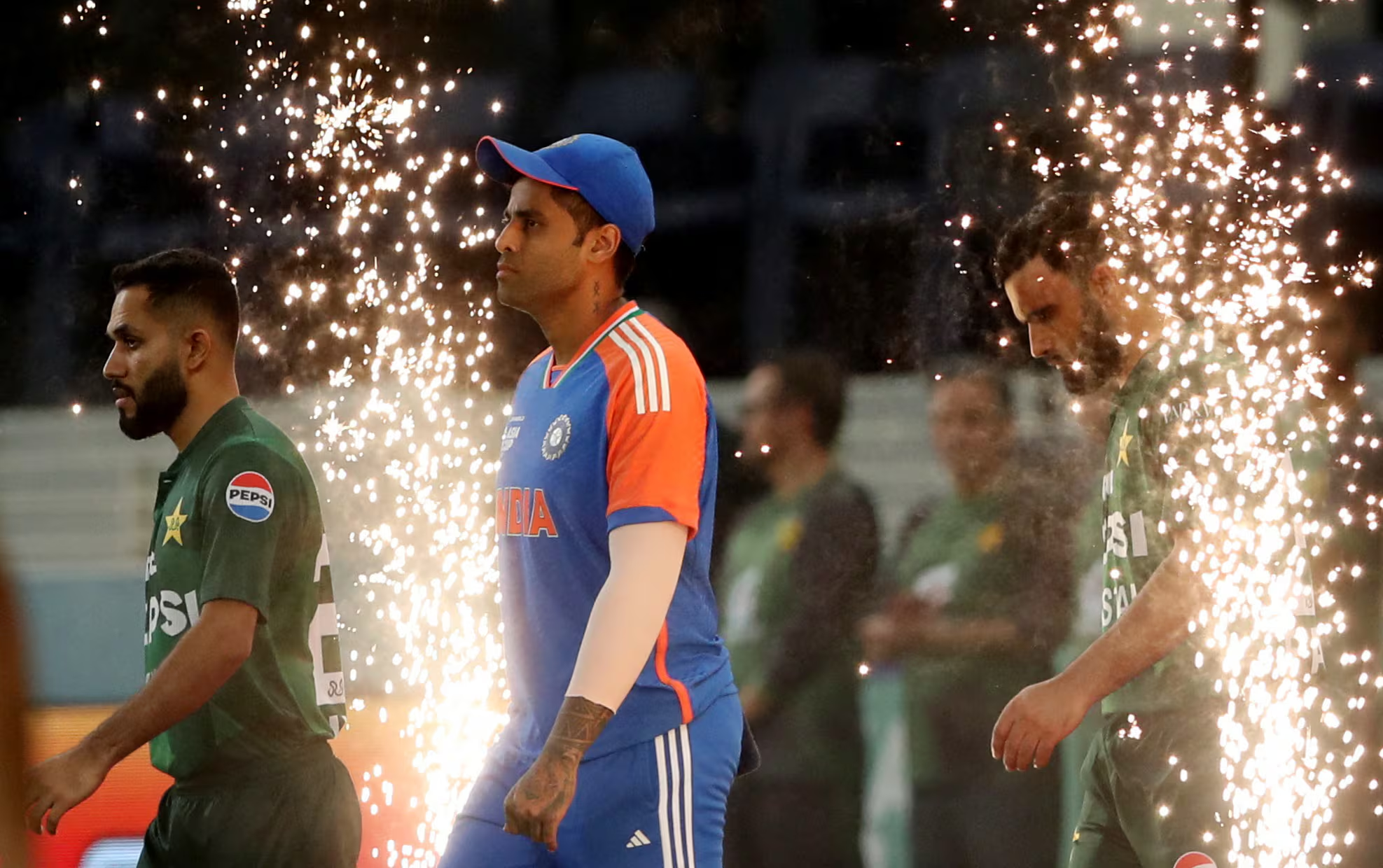
The 2025 Asia Cup final between India and Pakistan, held on September 28 at the Dubai International Stadium, was marked by a thrilling match and an unprecedented post-match controversy. India clinched their ninth Asia Cup title with a five-wicket victory, but the celebration was overshadowed by a refusal to accept the winner’s trophy from Pakistan Cricket Board (PCB) Chairman and Asian Cricket Council (ACC) President, Mohsin Naqvi. This has fueled massive controversy and brought to the forefront the convergence of politics and sports.
The Match: An Exhilarating Encounter
The last match was a drama of determination and prowess. Pakistan batted to set a total of 147 runs, but their innings began on a high note before collapsing to 146 all out. Kuldeep Yadav was the most outstanding Indian bowler, picking up 4 wickets for 30 runs, while Jasprit Bumrah, Varun Chakravarthy, and Axar Patel took two wickets each. India’s reply was hampered by early failures, taking their score to 20 for 3. But Tilak Varma played a steady inning of 69 runs off 53 balls not out, ably supported by Shivam Dube’s 33, to help India win with two balls to spare.
The Trophy Controversy
Even in the on-field victory, the post-game proceedings were tainted with a major controversy.
Indian players declined to receive the Asia Cup trophy from Mohsin Naqvi due to his being both the ACC President and the Interior Minister of Pakistan. The team asked for the trophy to be handed over by Khalid Al Zarooni, Vice-Chairman of the Emirates Cricket Board, but the request was refused. Consequently, the trophy presentation ceremony was postponed and ultimately reached its end without a ceremonial handover of the trophy. The Economic Times The captain of the team, Suryakumar Yadav, said that the team was “denied” the chance to hold the trophy aloft. He clarified that the true rewards were the support of his staff and teammates and the camaraderie.
Political Underpinnings
The refusal to receive the trophy was based on the political tensions prevailing between India and Pakistan.
In the earlier part of the tournament, Indian cricketers had avoided greeting their Pakistani counterparts with a handshake, and the Board of Control for Cricket in India (BCCI) had issued a formal complaint about the behavior of match officials.
The crisis deepened after Mohsin Naqvi posted controversial content on social media, with a video ridiculing India’s armed forces, further straining the relations. Hindustan Times The BCCI responded to the trophy controversy by announcing that it was planning to file a formal complaint with the International Cricket Council (ICC) for action and re-examination of the events leading up to the presentation.
International Reactions
The incident drew attention outside of the world of cricket. India’s actions were condemned by former Pakistan captain Shoaib Malik, who said that the team would “regret” the move in the future. Indian fans and pundits have mostly defended the actions of the team, seeing it as a matter of principle in standing up against disrespect.
The Times of India
The final of the Asia Cup, though displaying great cricket, highlighted the intricacies of international politics and how they reflect in sports. The refusal to receive the trophy stands as a poignant testimony to the larger geopolitical tensions often intersecting with the realm of sports.


