


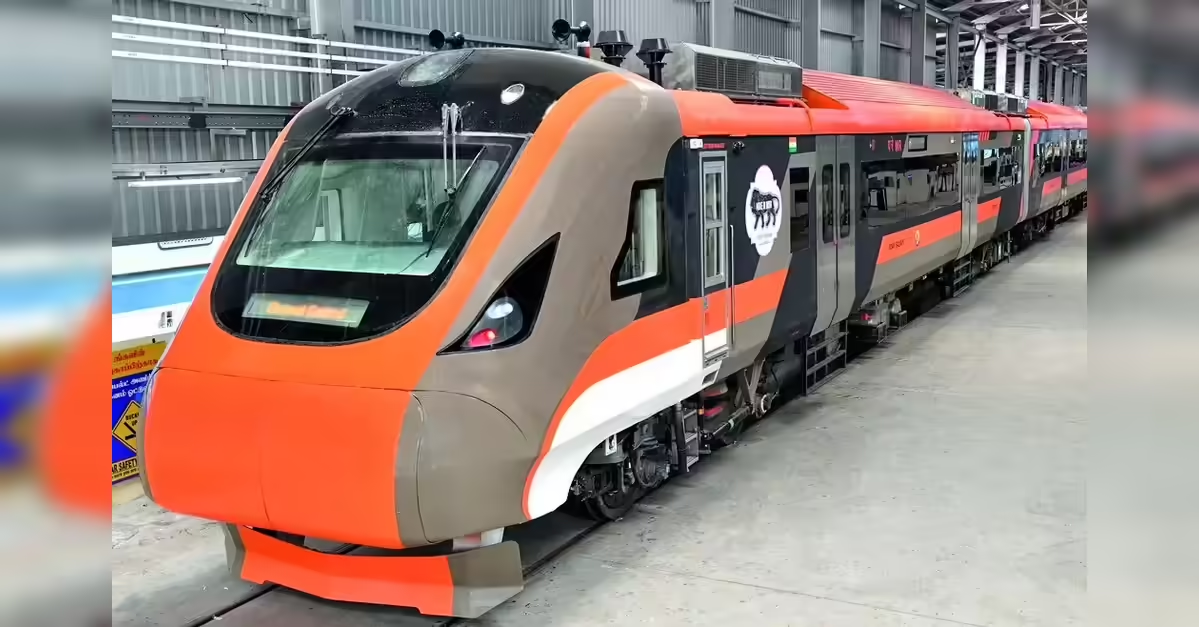
The Indian Railways announced on Tuesday that high-speed safety trials for the Vande Metro, a new generation of semi-high-speed trains for serving short-distance routes with better comfort, efficiency, and connectivity, have been successfully completed – a promising development for an upgrade in India’s urban and inter-city mobility. The tests were performed by RDSO on specially selected sections of track in Uttar Pradesh and Haryana, marking a decisive step toward the commercial rollout of the train.
The Vande Metro is the compact and commuter-friendly avatar of the highly successful Vande Bharat Express, engineered to address high-density passenger corridors between cities falling within a radius of 100–250 km. With an aim to cut travel time drastically, the new service boasts premium features at an economical fare, therefore becoming an attractive option for office-goers, students, and short-trip travelers.
Promising performance during trials
The evaluations undertaken during the week-long trials included testing Vande Metro at over 120 km/h, with evaluators looking for acceleration, braking efficiency, ride comfort, noise levels, and overall system robustness. Officials mentioned that the performance was exceptionally good for varying conditions like rapid speed changes, simulated congestion, and sudden braking sequences.
Still more impressive, though, was the stability of the train on high speed, made possible by upgraded suspension, a lightweight body made entirely of aluminium, and an aerodynamically optimized shape. The engineers commented that the train negotiated both straight and curved track sections with ease and thus met all safety standards required for Indian conditions.
According to senior railway officials, the successful completion of these tests implies that the Vande Metro has now been readied for the final phase of certification and may even start commercial operations by the first quarter of 2026.
Designed for India’s Short-Distance Commuters
With cities in India growing rapidly and inter-city mobility of the workforce increasing, the government is prioritizing fast, efficient, and eco-friendly transportation solutions. Vande Metro is a serious answer to this need.
Unlike long-distance Vande Bharat trains, the Vande Metro is likely to have:
Eight-car and twelve-car configurations
Faster acceleration and deceleration for frequent stops
Driverless or semi-driverless technology readiness in the future
Increased seating and standing room for peak-hour passengers
Plug-and-play communication systems, charging points, and real-time display screens
Improved accessibility features for senior citizens and differently-abled passengers are incorporated into the design of the train.
Boosting regional connectivity and economic development
According to government sources, the first phase of the operations of Vande Metro will focus on high-volume corridors including:
Delhi–Meerut
Bengaluru–Mysuru suburban stretch
Chennai–Tiruvallur
Mumbai–Pune fringe routes
These routes are likely to decongest traffic on the highways, reduce pollution, and cut travel times for lakhs of commuters daily. Public transport experts say the Vande Metro will introduce an era of regional rail commuting, allowing faster suburbanization and economic growth through better connectivity between satellite towns and big cities.
Part of the Indian Railways Modernization Drive
Vande Metro forms a part of the greater modernization in which the Ministry of Railways is engaging, including signalling, track infrastructure development, ATP technology installation, and the introduction of energy-efficient rolling stock.
Railway Minister Ashwini Vaishnaw termed the development “a proud moment for India’s technological capabilities,” adding that the Vande Metro would soon become a backbone for regional travel across multiple states.
These successful trials have also attracted international attention, as experts remark on the progress India has made in developing indigenous, world-class rail systems that can compete with European and East Asian commuter rail technologies.
Next Steps Before Commercial Launch
While the safety trials are a major milestone, there are still some steps left before the Vande Metro starts carrying passengers. The prototype unit will now undergo:
Final safety certification
Route mapping and timetable finalization
Crew training and simulation exercises
Platform modification at selected stations to support higher door alignment
Passenger feedback trials (optional pre-launch runs)
Once these steps are completed, announcement of the first official routes and their fare structures by Indian Railways is expected.
A Step Toward Faster, Smarter Indian Rail Travel Completion of high-speed trials positions Vande Metro as a game-changing solution for India’s emerging mobility needs. With its modern design, commuter-focused features, and fast turnaround, Vande Metro is well-positioned to change the dynamics of short-distance travel by train in the country. With India continuing to invest in advanced rail infrastructure, the Vande Metro stands as a beacon of the nation’s growing commitment to sustainable, rapid, and future-ready transportation systems.


