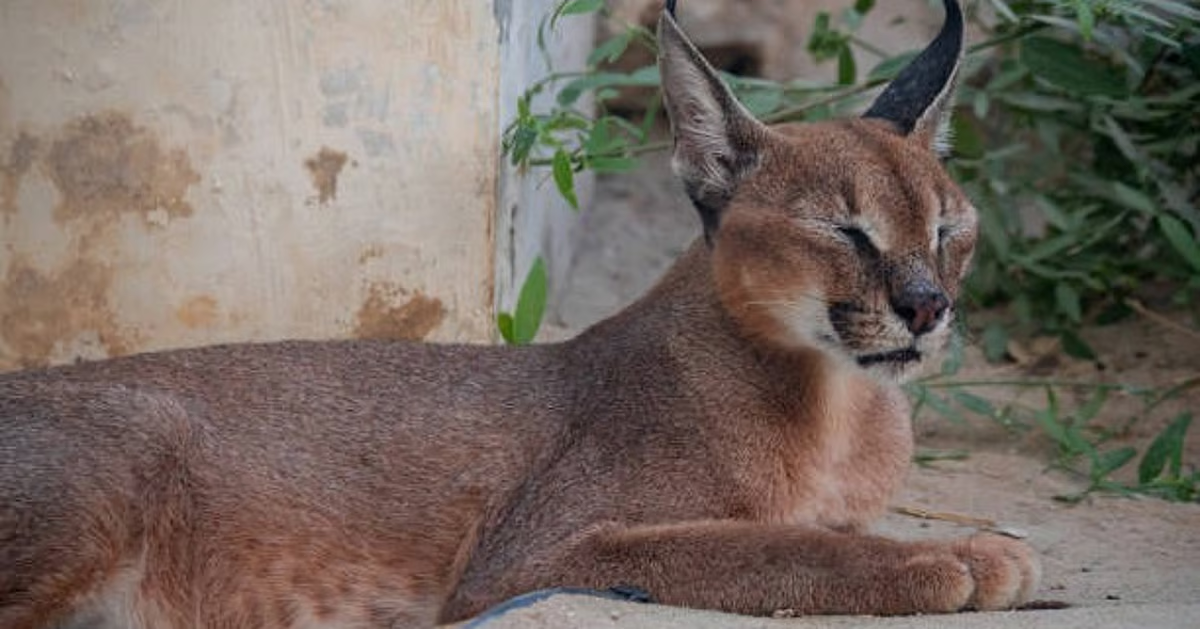


The highly skittish Asian Caracal, a medium-sized wild cat rarely spotted in the subcontinent, has been rediscovered in Rajasthan in what can be called a shot in the arm for the wildlife conservation community of India. This marvelous discovery reported lately from the Ramgarh grasslands of Jaisalmer has successfully rekindled hope for the survival of a species many believed was at the threshold of vanishing from India’s wild landscapes.
A team of conservationists and local trackers made the discovery, photographing multiple individuals. Preliminary estimates indicate there may be as many as ten pairs remaining in the Ramgarh area, a surprising total considering the sporadic sightings over the past few decades were highly contested. The Asian Caracal is a medium-sized cat with distinctive black-tufted ears and an elongated, muscular body; it was once widely distributed across India’s arid and semi-arid ecosystems but had largely vanished amidst habitat loss and declining prey availability.
This is one of the most important discoveries of wildlife in the recent past as it is not just the survival of a single species, but the resilience of an entire ecosystem. Dry grasslands and desert scrubs of Rajasthan- always considered less important than forests and tiger reserves-shelter several threatened species, including the Great Indian Bustard, desert fox, and Indian wolf. The presence of Caracal indicates that such habitats still remain ecologically functional and can support mid-level predators.
Experts in wildlife point out that the decline of the species has indeed been dramatic. Scientific evidence indicates that, within the last century, the Caracal’s historical range in India has shrunk by almost 96%. Once spread across northwestern and central India, today it inhabits only the most remote nooks of Rajasthan and parts of Kutch in Gujarat. The causes for this decline are well-documented: agricultural expansion, loss of natural grasslands, increase in human activity, dwindling prey base, and competition from feral dogs. When grasslands were taken over by agriculture and scrublands were converted to development projects, the Caracal was denied its territory as well as its food.
The current discovery, however, presents a rare opportunity to change that course of events. The conservationists associated with the Jaisalmer study have pointed out that the animals were detected in areas where human presence is at a minimum, the pressure of livestock is low, and their natural prey, like hares, birds, and small mammals, are still so common. These conditions create an environment in which Caracals can hunt, breed, and disperse naturally.
Incidentally, the rediscovery has generated fresh interest among policymakers as well as biologists. The Rajasthan forest department, reportedly, is preparing to undertake a focussed Caracal Conservation Programme including habitat mapping, population estimation, and long-term camera trap monitoring. Scientists point out that since the species falls under Schedule I of the Wildlife Protection Act-signifying the highest protection level-it should receive the same conservation accord as tigers or leopards.
Yet, significant challenges persist. The Ramgarh area and surrounding regions face increasing pressure from renewable energy projects, road construction, and mining activity. The placement of solar and wind turbines-most crucial for India’s green transition-on ecologically sensitive grasslands is raising alarms among conservationists. Large turbines, transmission lines, and fenced solar fields can fragment habitats, curtail animal movement, and cause direct mortality in birds and mammals.
Another growing threat is human-wildlife conflict, especially with the pastoralist communities whose goats and sheep graze around the caracal habitats. Though it rarely attacks livestock unless natural prey is scarce, retaliatory killing remains a danger. According to conservationists, community awareness programs and compensation mechanisms will be crucial to ensuring long-term coexistence.
The rediscovery also highlights the essentiality of the participation of local communities in studies concerning wildlife. In the Jaisalmer study, the involvement of local trackers was invaluable: they tracked pugmarks, identified resting sites, and understood seasonal movement patterns. Their traditional knowledge, along with modern scientific tools, proved of great value in confirming the species’ presence. Going forward, experts say, the Caracal’s survival will be ensured only through a multi-pronged strategy that involves habitat protection, scientific research, community participation, and policy support. They add that the sighting must not be considered indicative of a stable population but seen as a warning that urgent conservation action is required before the species disappears once again. The rediscovery of the Asian Caracal reminds one powerfully that the lesser-known ecosystems in India still harbour wildlife treasures worthy of attention and protection. In an age when the rate of biodiversity loss has increased across the world, this provides a hopeful peek into what is still possible when conservationists, communities, and authorities come together.


